

Back

How to Interact with Web3 Smart Contracts Using Decentralized RPC

Introduction

In Web3, smart contracts are the backbone of decentralized applications (dApps). They automate logic, handle assets, and enforce rules on-chain. But to interact with them, for example, to read data, send transactions, or deploy new contracts, your app must communicate with a blockchain node.

That communication happens through RPC (Remote Procedure Call) — the standard interface between your app and the blockchain. Using a decentralized RPC network ensures those calls are always available, fast, and secure.

In this guide, you’ll learn how to interact with Web3 smart contracts using decentralized RPC, step-by-step, with real code examples.

What Are Web3 Smart Contracts?

A Web3 smart contract is self-executing code deployed on a blockchain. Once deployed, its logic cannot be altered, only triggered. Each contract lives at a unique address and can store, send, or modify data depending on its functions.

Smart contracts enable:

  • Token creation (ERC-20, ERC-721, ERC-1155)

  • NFT minting

  • Automated trading and lending on DeFi platforms

  • Governance voting systems

  • DAOs and multi-sig wallets

Unlike traditional backend systems, smart contracts run on decentralized infrastructure, ensuring transparency and tamper resistance.

You can learn more about how smart contracts work in Ethereum.org’s introduction to smart contracts.

How RPC Works in Smart Contract Interactions

RPC, or Remote Procedure Call, allows applications to interact with blockchain nodes by sending requests such as eth_call or eth_sendTransaction.

In Web3.js, Ethers.js, or other frameworks, your application connects to a node (through an RPC endpoint) to:

  • Read on-chain data (balances, states, events)

  • Broadcast transactions

  • Listen for contract events

Here’s what typically happens:

  1. The dApp calls a contract method through a provider.

  2. The provider sends the RPC request to a blockchain node.

  3. The node processes it and returns the response.
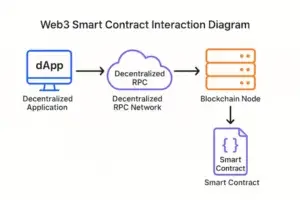
Web3 smart contract interaction diagram showing dApp, decentralized RPC, blockchain node, and smart contract flow
Diagram showing how decentralized RPC connects dApps with blockchain smart contracts.

Centralized vs. Decentralized RPC

A centralized RPC relies on a single company’s node infrastructure. If that provider goes down or throttles requests, your dApp stops responding.

A decentralized RPC, like dRPC.org, aggregates multiple globally distributed node providers into one network. It ensures:

  • No single point of failure

  • Automatic failover across multiple clusters

  • Consistent uptime and low latency

You can explore available decentralized endpoints on dRPC’s Chainlist.

Why Use Decentralized RPC for Web3 Smart Contracts

When interacting with smart contracts, reliability and speed are crucial. Decentralized RPC offers several advantages over centralized options:

Reliability & Redundancy

No single outage can take your application down. Each call is routed through multiple providers in parallel.

Lower Latency

Requests automatically use the closest node cluster geographically, reducing query time.

Scalability

Decentralized RPC networks handle bursts of transactions during high-traffic events (like NFT mints or airdrops) without rate limits.

Security

Redundant infrastructure protects you against malicious node responses and ensures data consistency.

Flexibility

Developers can connect to multiple blockchains or testnets from one endpoint, ideal for multi-chain dApps.

Connect to your favorite blockchain with dRPC’s decentralized RPC network.

Step-by-Step Guide: How to Interact with Smart Contracts Using dRPC

Below is a simple workflow for interacting with a deployed contract using Web3.js and a decentralized RPC endpoint.

Step 1 – Connect to a Decentralized RPC Endpoint

Start by creating a connection to a blockchain node.

For example, connect to Ethereum Mainnet through a dRPC endpoint:

				
					import Web3 from "web3";

// Connect to decentralized RPC endpoint
const web3 = new Web3("https://lb.drpc.live/eth");


You can find other networks (like Polygon, Arbitrum, or Base) on dRPC Chainlist.

Step 2 – Load the Smart Contract ABI

The ABI (Application Binary Interface) defines how to interact with a contract — its functions, inputs, and outputs.

				
					const abi = [
  {
    "constant": true,
    "inputs": [{ "name": "account", "type": "address" }],
    "name": "balanceOf",
    "outputs": [{ "name": "", "type": "uint256" }],
    "type": "function"
  }
];

const contractAddress = "0xYourContractAddressHere";
const contract = new web3.eth.Contract(abi, contractAddress);


If you’re using Ethers.js, the equivalent would be:

				
					import { ethers } from "ethers";
const provider = new ethers.JsonRpcProvider("https://lb.drpc.live/eth");
const contract = new ethers.Contract(contractAddress, abi, provider);


Learn more about ABIs in the Ethers.js documentation.

Step 3 – Read Data from the Contract

You can query on-chain data using a “call,” which doesn’t consume gas.

				
					const balance = await contract.methods.balanceOf("0x1234...").call();
console.log(`User balance: ${balance}`);


This request runs through the decentralized RPC network, automatically balancing load and ensuring consistent uptime even under heavy demand.

Step 4 – Send Transactions to the Contract

To modify the blockchain state, you’ll send a transaction — for instance, transferring tokens or minting an NFT.

				
					const account = web3.eth.accounts.privateKeyToAccount("0xYourPrivateKey");
web3.eth.accounts.wallet.add(account);

const tx = contract.methods.transfer("0xReceiver", web3.utils.toWei("10"));
const receipt = await tx.send({
  from: account.address,
  gas: 200000
});
console.log(`Transaction confirmed: ${receipt.transactionHash}`);


dRPC routes the request through multiple clusters, minimizing the chance of failed submissions or timeouts.

Step 5 – Monitor and Verify Results

After sending a transaction, monitor its status and handle potential retries:

				
					web3.eth.subscribe("newBlockHeaders", (error, blockHeader) => {
  if (!error) console.log(`New block mined: ${blockHeader.number}`);
});


Using decentralized RPC ensures that even if one node misses a block event, another will deliver it — maintaining reliability and data consistency.

Example Code for Interacting with Web3 Smart Contracts

Here’s a complete example you can run locally or adapt to your framework:

				
					import Web3 from "web3";
const web3 = new Web3("https://lb.drpc.live/eth");

const abi = [
  {
    "constant": true,
    "inputs": [{ "name": "account", "type": "address" }],
    "name": "balanceOf",
    "outputs": [{ "name": "", "type": "uint256" }],
    "type": "function"
  }
];

const address = "0xYourContractAddress";
const contract = new web3.eth.Contract(abi, address);

(async () => {
  const balance = await contract.methods.balanceOf("0xUser").call();
  console.log(`Balance: ${balance}`);
})();


You can test this on Sepolia or Goerli testnets using dRPC testnet endpoints.

Common Errors and How to Fix Them

ERROR

CAUSE

FIX / PREVENTION

RPC timeout or rate limit

Centralized RPC limits throughput

Use a decentralized endpoint (e.g. dRPC) with built-in load balancing

Invalid contract address

Address doesn’t point to a contract

Verify on Etherscan or your explorer

ABI mismatch

ABI doesn’t match deployed contract

Recompile contract and use correct ABI

Out of gas

Gas limit too low

Increase gas or estimate automatically

Transaction reverted

Contract condition not met

Use call() first to simulate before sending transaction

Because dRPC connects to multiple providers simultaneously, it minimizes failures due to node errors or slow responses.

FAQs

What is a Web3 smart contract?

A Web3 smart contract is self-executing code deployed on a blockchain, executing logic automatically once triggered by transactions. They’re used for tokens, DAOs, DeFi, and NFTs.

How do I interact with a smart contract using RPC?

You connect your app to an RPC node (via Web3.js or Ethers.js), load the contract ABI and address, and call its functions using call() or sendTransaction().

Why use decentralized RPC for smart contract interactions?

Because it prevents single points of failure, improves uptime, and provides consistent latency across regions — essential for production-grade dApps.

Can I use dRPC with web3.js or ethers.js?

Yes. dRPC endpoints are fully compatible with both libraries and any EVM-based chain.

Is decentralized RPC faster than centralized providers?

In most cases, yes — thanks to geographic load balancing and multi-provider routing that reduces query latency and avoids congested nodes.

Take-Away

Smart contract interactions form the core of every Web3 application. Whether you’re building DeFi tools, on-chain games, or NFT marketplaces, your app’s stability depends on the reliability of your RPC layer.

By using a decentralized RPC network such as dRPC, you ensure:

  • Consistent performance

  • Uptime across global regions

  • Built-in redundancy against node outages

  • Simple, multi-chain integration

Build your next smart contract project using dRPC — self-hosted, fast, and built for developers who value reliability.

Explore dRPC’s decentralized RPC network.
Check dRPC Docs.

Grow with our community

Join a fast-growing community of developers and innovators connected all over the world, building the new era of the internet.

dRPC green logo text black transparent

© 2025 dRPC. All rights reserved.