

Introduction
Arbitrum has become one of the most widely adopted Ethereum Layer 2 networks, offering faster transactions and significantly lower fees while preserving Ethereum’s security model. As more users and developers interact with tokens on Arbitrum, understanding how Arbitrum token addresses work is no longer optional—it’s essential.
Whether you’re sending tokens, integrating assets into a dApp, or querying balances programmatically, the token address is the foundation of every interaction. This guide explains what an Arbitrum token address is, how it differs from wallet addresses, where to find verified token contracts, and how to use them safely with wallets, explorers, and RPC endpoints.
What Is an Arbitrum Token Address?
An Arbitrum token address is the unique smart contract address that represents a token deployed on the Arbitrum network. Most tokens on Arbitrum follow Ethereum standards such as ERC-20, ERC-721, or ERC-1155, meaning their behavior is defined by smart contract code rather than by wallets themselves.
It’s important to distinguish between:
Wallet address: Your externally owned account (EOA) used to send and receive assets
Token address: The smart contract that defines a token’s logic, supply, and balances
Wallets do not “store” tokens directly. Instead, they read token balances from token contracts deployed on Arbitrum. Without the correct token address, wallets and dApps cannot locate or display your assets.
Why You Need an Arbitrum Token Address
Knowing the correct token address is critical for several reasons:
Secure transfers
Sending tokens to the wrong contract address can result in permanent loss.
Wallet visibility
Custom or newly launched tokens often require manual token address entry to appear in wallets.
dApp integration
Smart contracts must reference token addresses explicitly for swaps, staking, or payments.
RPC queries
Developers rely on token contract addresses to fetch balances, metadata, and events using RPC calls.
In short, token addresses are the glue between wallets, smart contracts, and infrastructure.
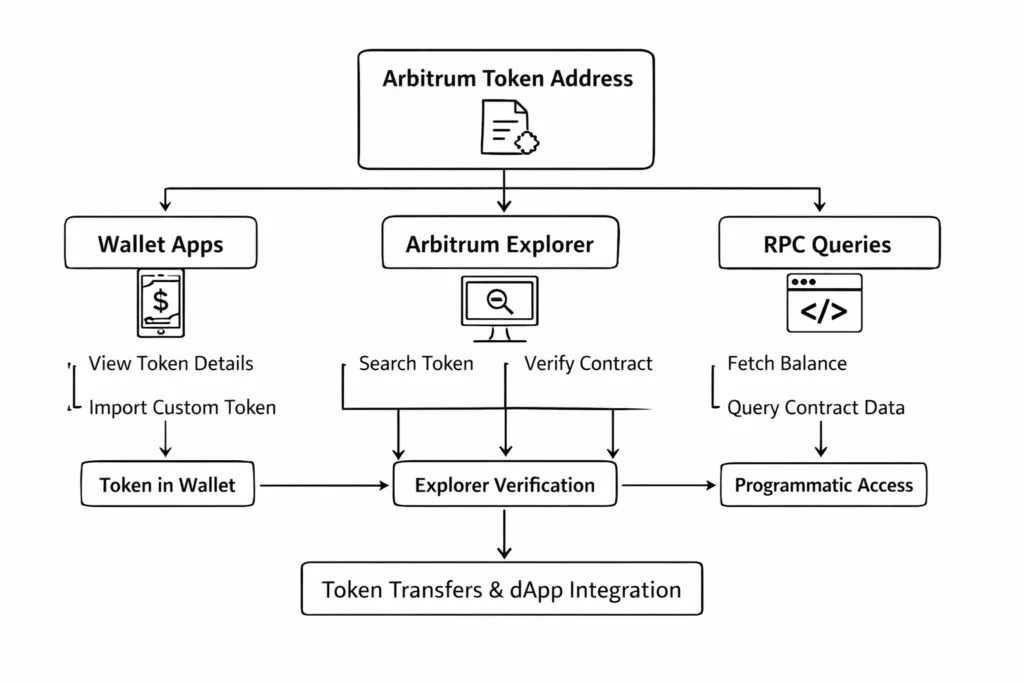
Ways to Find Arbitrum Token Addresses
Using Arbitrum Block Explorers
The most reliable way to find a verified token address is via the official Arbitrum block explorer:
👉 https://explorer.arbitrum.io
Step-by-step:
Open the explorer and select Tokens
Search by token name or symbol
Open the token page
Copy the verified contract address from the overview section
Always check:
Token symbol
Decimals
Holder count
Verification status
These details help you avoid phishing or spoofed tokens.
Via Wallet Apps (MetaMask, Ledger, Rainbow)
Most wallets automatically detect popular Arbitrum tokens, but lesser-known assets require manual addition.
Typical steps:
Switch your wallet network to Arbitrum
Select Import token or Add custom token
Paste the token contract address
Confirm symbol and decimals
If the token details auto-fill, that’s a good sign you’re using a valid contract.
Internal resource:
Learn how to manage Arbitrum wallet tokens efficiently (related blog)
Using dRPC Arbitrum RPC Endpoints
For developers, token discovery and balance checks are often automated through RPC calls.
Using a reliable RPC provider like dRPC ensures:
Fast response times
Accurate state reads
No rate-limit surprises during production traffic
Example (ERC-20 balance query logic):
Call eth_call
Target the token contract address
Encode balanceOf(walletAddress)
Decode the returned value
You can query Arbitrum token balances with dRPC RPC endpoints.
Third-Party Token Lists & Documentation
Additional trusted sources include:
Arbitrum ecosystem documentation
Official project GitHub repositories
DeFi protocol documentation referencing deployed token contracts
Always cross-check addresses against the block explorer before use.
Best Practices for Using Arbitrum Token Addresses
Always verify the contract address on the Arbitrum explorer
Avoid copying addresses from random social posts or DMs
Use separate wallets for mainnet and testnet interactions
Keep a documented list of frequently used token addresses for your project
Use reliable RPC endpoints to prevent stale or inconsistent reads
Infrastructure reliability matters just as much as correct addresses.
Common Issues and How to Solve Them
Token Not Appearing in Wallet
Cause: Token not auto-detected
Solution: Manually add the token using the verified contract address
RPC Query Errors or Inconsistent Balances
Cause: Overloaded or public RPC endpoints
Solution: Switch to dedicated, low-latency endpoints such as dRPC.
Explore the top Arbitrum RPC providers for reliable token queries and dApp performance.
Confusion Between Mainnet and Testnet
Cause: Same token deployed at different addresses
Solution: Double-check network selection and explorer domain
How dRPC Simplifies Arbitrum Token Queries
dRPC provides dedicated Arbitrum RPC endpoints designed for production workloads.
Benefits include:
Low-latency global infrastructure
Consistent token balance queries
No shared validator bottlenecks
Reliable reads for wallets and dApps
Developers can confidently fetch:
Token balances
Contract metadata
Event logs
Transaction states
Explore dRPC’s Arbitrum RPC endpoints here:
https://drpc.org/chainlist/arbitrum-mainnet-rpc
Take-Away
Understanding and correctly using an Arbitrum token address is essential for secure transactions, accurate wallet balances, and reliable dApp integrations. Whether you’re a user managing assets or a developer building production-grade applications, verified token addresses and dependable RPC infrastructure go hand in hand.
By combining trusted explorers with dRPC’s low-latency Arbitrum RPC endpoints, you ensure fast, accurate, and scalable token interactions, without unnecessary complexity.
Explore dRPC and get started here:
FAQs
What is an Arbitrum token address?
An Arbitrum token address is the smart contract address representing a token deployed on the Arbitrum network. It defines how balances, transfers, and approvals work.
How can I find a token address on Arbitrum?
Use the official Arbitrum block explorer, trusted documentation, or verified token lists. Always confirm details before using the address.
Can I use RPC to fetch Arbitrum token balances?
Yes. RPC calls allow you to query token contracts directly for balances and metadata, provided you know the token address.
How do I verify Arbitrum token addresses for dApps?
Cross-check addresses on the Arbitrum explorer, confirm contract verification, and match token metadata such as symbol and decimals.
How does dRPC improve Arbitrum token queries?
dRPC offers dedicated, low-latency RPC endpoints that deliver accurate and consistent token data without public RPC congestion.