


Solana has established itself as one of the most performant blockchains for decentralized finance. With high throughput, low fees, and fast finality, it has become a natural home for DeFi applications that require speed and scalability. At the center of this ecosystem are decentralized exchanges (DEXs), which power token swaps, liquidity provision, and on-chain trading logic.
For builders, choosing the best Solana DEX is not only about liquidity or UX. It is also about infrastructure: execution speed, RPC reliability, indexing access, and how well a DEX integrates into a broader DeFi stack. In this guide, we break down the best Solana DEXs for DeFi development, explain how they work under the hood, and show how reliable RPC infrastructure plays a critical role in scaling production-grade applications.
Understanding Solana DEXs
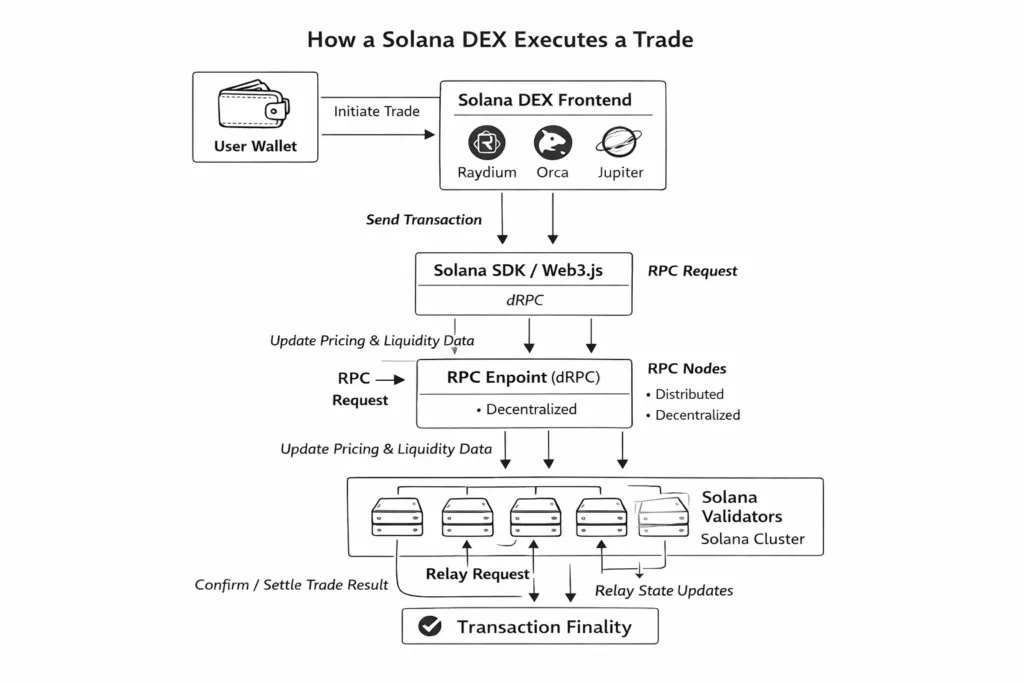
A decentralized exchange (DEX) is a protocol that allows users to trade tokens directly on-chain without relying on a centralized intermediary. On Solana, DEXs benefit from the network’s architecture, which enables parallel transaction execution and sub-second block times.
Unlike Ethereum-based DEXs that often struggle with congestion and gas spikes, Solana DEXs can support:
High-frequency trading
Real-time price discovery
Large liquidity pools
Low-cost swaps and arbitrage
For developers, every interaction with a Solana DEX — placing orders, fetching order books, querying liquidity, or executing swaps — depends on Solana RPC endpoints. RPC nodes act as the gateway between your application and the Solana network, making infrastructure a first-class concern when building or scaling DeFi products.
Key Features to Look for in a Solana DEX
When evaluating the best Solana DEX for your DeFi project, focus on more than surface-level metrics. From an engineering perspective, the following factors matter most:
Liquidity Depth and Volume
High liquidity reduces slippage and improves price execution. DEXs with deeper liquidity pools are more suitable for large trades and institutional-grade DeFi products.
Execution Speed and Finality
Solana’s advantage is speed, but not all DEXs leverage it equally. Look for platforms optimized for fast settlement and minimal transaction retries.
Token Coverage and Composability
A strong Solana DEX should support a wide range of SPL tokens and integrate easily with other protocols, such as lending platforms, yield aggregators, and NFT marketplaces.
Smart Contract and Wallet Integration
DEXs must integrate cleanly with Solana wallets and SDKs. Poor integration increases friction for both developers and end users.
Infrastructure Reliability (RPC Layer)
Even the best DEX logic fails without reliable RPC access. DeFi platforms rely on low-latency, decentralized RPC endpoints to avoid downtime, rate limits, and degraded performance during peak trading periods.
Top Solana DEXs for Developers (2026 List)
Below is a developer-focused comparison of the top Solana DEXs commonly used in production DeFi applications.
Solana DEX Comparison Table
Add Your Heading Text Here
DEX
MODEL
LIQUIDITY
SPEED
TOKEN SUPPORT
DEVELOPER USE CASE
Order book
High
Very fast
Broad
Professional trading, market making
AMM + Order Book
High
Fast
Broad
Liquidity provision, DeFi primitives
AMM
Medium
Fast
Curated
UX-focused swaps
MERCURIAL FINANCE
Dynamic MM
Medium
Fast
Stable-focused
Stablecoin DeFi
Serum
Serum pioneered the on-chain central limit order book on Solana. It is ideal for professional trading applications that require precise price discovery and deep liquidity. Serum relies heavily on fast RPC access due to frequent state queries and order updates.
Raydium
Raydium combines an AMM with Serum’s order book, making it a core liquidity layer for Solana DeFi. Many protocols build directly on Raydium pools, making it a strong candidate when evaluating the best Solana DEX for composable DeFi systems.
Orca
Orca focuses on simplicity and UX. While liquidity is more curated, it is often chosen for consumer-facing DeFi apps and token launches that prioritize ease of use.
Jupiter
Jupiter is not a DEX itself but an aggregator that routes trades across multiple Solana DEXs. From a developer standpoint, Jupiter is essential for achieving optimal pricing and liquidity fragmentation mitigation.
Mercurial Finance
Mercurial Finance is a Solana DeFi protocol focused on efficient liquidity for stable and correlated assets. It uses dynamic market making to optimize capital allocation, making it ideal for stablecoin-centric DeFi and treasury use cases.
How dRPC Enhances Solana DEX Performance
Regardless of which Solana decentralized exchange you choose, infrastructure determines how well your application performs under load. This is where decentralized RPC becomes critical.
dRPC provides decentralized, low-latency Solana RPC endpoints that help DeFi applications:
Execute swaps faster during high-volume trading
Avoid RPC bottlenecks during market volatility
Maintain uptime during peak DeFi usage
Reduce dependency on single-provider RPC setups
For DEX developers, this translates into better user experience, fewer failed transactions, and more predictable application behavior.
You can explore Solana RPC endpoints here:
How to Connect Your DeFi Project to Solana RPC
Connecting a DeFi application to Solana requires minimal setup, but production reliability depends on RPC quality.
Example: Connecting with Solana Web3.js
					import { Connection, clusterApiUrl } from "@solana/web3.js";

const connection = new Connection(
  "https://drpc.org/chainlist/solana-mainnet-rpc",
  "confirmed"
);

const slot = await connection.getSlot();
console.log("Current slot:", slot);
Best Practices
Test on Devnet before deploying to Mainnet
Use dedicated RPC endpoints for production workloads
Monitor latency and error rates during peak usage
Avoid public RPC endpoints for high-volume DeFi applications
Reliable RPC access is a prerequisite for scaling any best Solana DEX integration.
Why RPC Infrastructure Matters for Solana DeFi
Solana DeFi applications are uniquely sensitive to infrastructure quality. High throughput means higher expectations: users notice delays immediately.
Common issues with poor RPC setups include:
Transaction confirmation delays
Missed order book updates
Inconsistent swap execution
Downtime during NFT or DeFi spikes
Using decentralized RPC providers like dRPC reduces these risks by distributing traffic across multiple independent node operators and geographies.
Learn more about Solana development directly from the ecosystem:
FAQs
What is the best Solana DEX for developers?
The best Solana DEX depends on your use case. Serum and Raydium are ideal for liquidity-heavy DeFi, while Jupiter is essential for price aggregation.
How do Solana RPC endpoints improve DEX performance?
Low-latency RPC endpoints reduce transaction delays, improve state synchronization, and prevent downtime during peak trading.
Which Solana DEXs support high-volume token swaps?
Raydium, Serum, and Jupiter are commonly used for high-volume trading and liquidity routing.
Can I use the same RPC endpoint for multiple DeFi applications?
Yes, but production applications should use scalable, decentralized RPC endpoints to avoid congestion.
How does dRPC help scale Solana DeFi projects?
dRPC provides decentralized, high-performance Solana RPC infrastructure designed for reliability, speed, and global coverage.
Take-Away
Choosing the best Solana DEX is a critical decision for any DeFi project, but it is only half of the equation. Execution speed, liquidity access, and user experience ultimately depend on the quality of your RPC infrastructure.
By combining leading Solana DEXs with decentralized, low-latency RPC endpoints, developers can build DeFi applications that scale reliably under real-world conditions. dRPC offers the infrastructure foundation needed to support high-performance Solana trading, NFT swaps, and DeFi platforms — without compromising on decentralization or resilience.
If you are building on Solana and planning to scale, start by strengthening your RPC layer.