Introduction
Before deploying on the BNB Chain mainnet, developers rely on the BNB Testnet to safely test, debug, and optimize smart contracts. The testnet mimics mainnet conditions but uses test tokens instead of real assets.
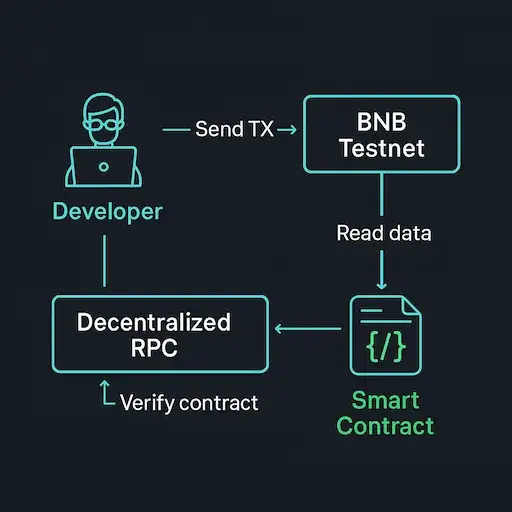
To connect your local environment or dApp to this test network, you’ll use RPC endpoints (Remote Procedure Calls). RPCs enable your tools — such as web3.js, ethers.js, or Remix IDE — to communicate directly with blockchain nodes.
In this guide, you’ll learn how to connect, deploy, and test smart contracts on the BNB Testnet using decentralized RPC endpoints from dRPC, ensuring consistent performance and uptime.
What Is the BNB Testnet?
The BNB Testnet is a public testing environment that mirrors the BNB Smart Chain (BSC) mainnet. It allows developers to validate contract logic, run transaction simulations, and detect issues before production deployment.
Mainnet vs. Testnet
FEATURE
BNB MAINNET
BNB TESTNET
Token
BNB (real value)
tBNB (test value)
Network ID
56
97
Use case
Production trnasactions
Testing and debugging
RPC URL
https://bsc-dataseed.binance.org/
https://lb.drpc.live/bnb-testnet
Why test first?
Detect gas logic errors and event misfires.
Validate contract storage and function results.
Simulate high-load or multi-transaction scenarios.
Testing on the BNB Testnet helps prevent high-cost failures once contracts go live on the mainnet.
Read Our Official Documentation: BNB Chain Docs.
Understanding RPC Endpoints in the BNB Ecosystem
What Is an RPC Endpoint?
RPC (Remote Procedure Call) endpoints are gateway URLs that your application uses to interact with blockchain nodes.
They enable Web3 tools to:
Send transactions
Query blockchain data
Call contract functions
Example RPC call (using web3.js):
const Web3 = require("web3");
const web3 = new Web3("https://lb.drpc.live/bnb-testnet");
const blockNumber = await web3.eth.getBlockNumber();
console.log("Latest block:", blockNumber);
Centralized vs. Decentralized RPC
TYPE
DESCRIPTION
PROS
CONS
Centralized
Single-provider RPC endpoint
Simple setup
Prone to downtime or rate limits
Decentralized
Aggregates multiple independent providers
High uptime, auto failover
Slightly higher initial latency
Using decentralized RPCs like dRPC ensures stable connectivity across multiple node clusters, reducing timeouts during contract testing.
Setting Up the Development Environment
Requirements
To deploy and test contracts, install the following:
Node.js (v16 or later)
npm or yarn
web3.js or ethers.js
MetaMask (for signing transactions)
Remix IDE or Hardhat (for compilation and deployment)
Connecting to the BNB Testnet RPC
Set your provider to the BNB Testnet RPC endpoint.
Example using web3.js:
const Web3 = require("web3");
const web3 = new Web3("https://lb.drpc.live/bnb-testnet");
Or using ethers.js:
import { ethers } from "ethers";
const provider = new ethers.JsonRpcProvider("https://lb.drpc.live/bnb-testnet");
💡 You can also connect via Chainlist:
https://drpc.org/chainlist/bnb-testnet-rpc
Get Testnet Tokens
You’ll need tBNB to pay for gas when deploying contracts.
Request test tokens from the BNB Faucet:
👉 https://testnet.bnbchain.org/faucet-smart
Deploying a Smart Contract on BNB Testnet
Step 1 – Compile the Smart Contract
Use Remix, Truffle, or Hardhat to compile your Solidity source file.
Example: a simple HelloWorld.sol contract.
// SPDX-License-Identifier: MIT
pragma solidity ^0.8.0;
contract HelloWorld {
string public message = "Hello, BNB Testnet!";
function updateMessage(string calldata newMessage) external {
message = newMessage;
}
}
Compile using Solidity 0.8.x and ensure your environment uses the correct compiler version.
Step 2 – Connect to BNB Testnet via RPC Endpoint
Establish the RPC connection before deployment. Example using ethers.js:
Compile using Solidity 0.8.x and ensure your environment uses the correct compiler version.
⸻
Step 2 – Connect to BNB Testnet via RPC Endpoint
Establish the RPC connection before deployment. Example using ethers.js:
This setup uses a decentralized dRPC endpoint, ensuring stable connectivity during contract deployment and testing.
Step 3 – Deploy the Contract
Use a deployment script to publish the contract:
const factory = new ethers.ContractFactory(abi, bytecode, wallet);
const contract = await factory.deploy();
await contract.waitForDeployment();
console.log("Contract deployed to:", contract.target);
Once confirmed, verify the deployment on BscScan Testnet by entering your contract address.
Step 4 – Interact with the Contract
After deployment, you can read or write data using RPC calls.
Read-only function (no gas):
const message = await contract.message();
console.log("Current message:", message);
Write function (requires gas):
const tx = await contract.updateMessage("BNB RPC works!");
await tx.wait();
console.log("Transaction confirmed!");
Using decentralized RPC endpoints prevents failed requests when the network is under heavy load or when centralized endpoints experience rate limits.
Troubleshooting Common Testnet Issues
ISSUE
POSSIBLE CAUSE
SOLUTION
“Invalid RPC endpoint”
Typo or outdated RPC URL
Use verified endpoint: https://lb.drpc.live/bnb-testnet
RPC timeout
Centralized node slag
Use decentralized RPC (dRPC auto-routes requests)
“Out of gas”
Low tBNB balance
Top up via BNB Testnet Faucet
Rate limit exceeded
API provider throttling
Decentralized RPCs have distributed throughput
Transaction not appearing

Network delay
Check on BscScan Testnet
Using dRPC’s decentralized node infrastructure minimizes timeouts, improves reliability, and automatically balances request loads.
Best Practices for Testing on BNB Testnet
Use Dedicated Test Wallets
Keep private keys separate from mainnet accounts to avoid accidental token loss.
Simulate Real Conditions
Reproduce mainnet scenarios: high gas fees, large transactions, and event-heavy contracts.
Track Network Latency
Use metrics like response time and dropped calls to identify bottlenecks.
Keep RPCs Decentralized
Avoid depending on single-node endpoints. dRPC routes queries through multi-provider clusters, maintaining uptime >99.9%.
Automate Testing
Integrate with Hardhat or Truffle to automate contract deployment and validation through RPC scripts.
Monitor Logs and Events
Use eth_getLogs and eth_subscribe to validate emitted events and ensure correct indexing.
Why Choose dRPC for BNB Testnet Development
dRPC provides a decentralized RPC infrastructure optimized for developers building and testing on BNB Chain.
Key Features:
Global Redundancy – Multi-cluster architecture ensures your requests are always served from the nearest active region.
Fast Response Time – Load balancing across node providers lowers latency during deployment and testing.
Scalability – Ideal for teams running parallel tests or CI/CD pipelines.
Multi-Chain Access – Unified access to BNB Testnet, Ethereum, Polygon, Arbitrum, Base, and more via a single domain.
Seamless Integration – Fully compatible with Hardhat, Truffle, Remix, Web3.js, and Ethers.js.
Example integration with Hardhat:
networks: {
bnbTestnet: {
url: "https://lb.drpc.live/bnb-testnet",
accounts: [PRIVATE_KEY]
}
}
Connect to BNB Testnet RPC with dRPC for faster contract testing: https://drpc.org/chainlist/bnb-testnet-rpc
FAQs
What is the BNB Testnet RPC?
The BNB Testnet RPC is a node access point that allows developers to send transactions and interact with contracts on the BNB Testnet.
How do I connect to the BNB Testnet using Web3?
Initialize a Web3 or Ethers.js provider using the endpoint:
https://lb.drpc.live/bnb-testnet
Where can I get BNB Testnet tokens?
Request tBNB from the official BNB Faucet to cover gas costs during testing.
How do I deploy a contract on the BNB Testnet?
Compile the contract using Remix or Hardhat, connect your provider to the BNB Testnet RPC, and broadcast the deployment transaction.
What is the best RPC provider for BNB Testnet?
dRPC provides decentralized, low-latency RPC endpoints with automatic failover, ensuring maximum uptime and consistency for developers
Conclusion
Testing on the BNB Testnet is an essential step before deploying smart contracts to the mainnet.
By connecting through BNB Testnet RPC endpoints, developers can safely validate contract logic, debug functions, and simulate transactions.
Using a decentralized RPC provider such as dRP guarantees consistent uptime, balanced load handling, and low latency — ensuring you can test contracts confidently without worrying about node failures or slow response times.
Test your smart contracts confidently using dRPC’s decentralized BNB RPC endpoints.