

Back

Sepolia USDC Token Address: How to Find & Use It Easily

Learn how to find the Sepolia USDC token address and use it safely in testnet wallets and dApps. Practical methods, RPC queries, and testing tips.

Introduction

USDC has become one of the most widely used stablecoins in Web3 development. Beyond production environments, developers rely heavily on USDC in testnets to simulate real world payment flows, DeFi interactions, and contract logic without risking real funds. On Ethereum, Sepolia has emerged as the primary long term testnet, replacing Goerli for most new development workflows.

To work effectively with USDC on Sepolia, developers must understand where the Sepolia USDC token address comes from, how it differs from mainnet deployments, and how to safely query and use it in wallets, scripts, and smart contracts.

This guide walks through practical methods to find the Sepolia USDC token address, verify it, and interact with it using explorers, wallets, and RPC calls. It also explains common pitfalls that cause confusion during testnet development and how to avoid them.

What Is the Sepolia USDC Token Address?

Sepolia is an Ethereum testnet designed specifically for application development and infrastructure testing. Unlike mainnet, assets on Sepolia have no real economic value. Tokens such as ETH or USDC exist purely to enable testing.

The Sepolia USDC token address refers to the smart contract address that represents a testnet deployment of USDC on Sepolia. This contract mimics the behavior of mainnet USDC but does not represent real dollars or Circle issued funds.

It is important to understand that Sepolia USDC is not interchangeable with mainnet USDC. Even if the token name and decimals are identical, the contract address is completely different and only valid on the Sepolia network.

Circle maintains official documentation for USDC deployments and test environments. Developers should always cross reference token information with authoritative sources rather than copying addresses from random repositories.

Why You Need the Sepolia USDC Token Address

Knowing the correct Sepolia USDC token address is essential for multiple development tasks.

First, it allows safe testing of token transfers without financial risk. Developers can simulate deposits, withdrawals, and payment flows using wallets connected to Sepolia.

Second, it enables smart contract testing. Many contracts integrate USDC for payments, staking, or accounting logic. Using the correct token address ensures that contract calls behave exactly as expected before deploying to mainnet.

Third, it ensures accurate balance queries. Whether you are building a frontend dashboard or backend service, RPC calls require the correct contract address to return valid balances.

Finally, it avoids costly mistakes. Confusing Sepolia USDC with mainnet USDC or using an incorrect testnet address is one of the most common causes of failed transactions and empty balances during development.

Ways to Find the Sepolia USDC Token Address
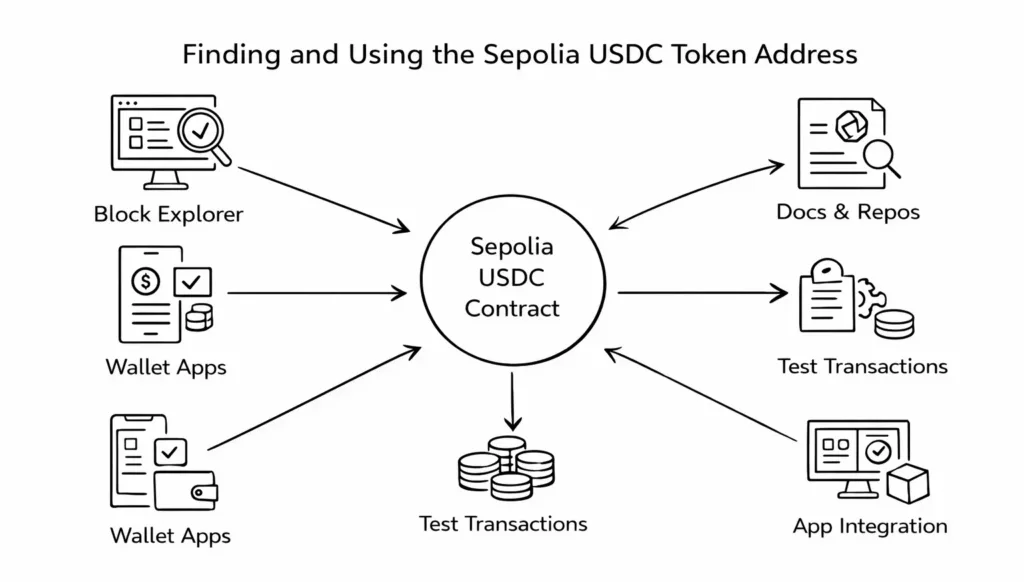
Diagram showing how developers find and use the Sepolia USDC token address via block explorers wallets and RPC calls

Using Sepolia Block Explorers

The most reliable way to verify the Sepolia USDC token address is through the official Sepolia block explorer.

Start by opening the Sepolia explorer and searching for USDC in the token section. Once you locate the contract, verify that it shows standard ERC20 functions and recent transactions. Always confirm the network selector shows Sepolia and not Ethereum mainnet.

This approach ensures that you are using a verifiable onchain source rather than copying addresses from third party posts.

Using Wallet Apps

Wallets such as MetaMask allow developers to add custom tokens manually. When connected to Sepolia, you can paste the USDC contract address into the add token interface. If the address is correct, the wallet will automatically populate the token symbol and decimals.

This method is especially useful when testing user flows. You can immediately confirm whether tokens appear correctly in the wallet and whether transfers update balances as expected.

Querying via Sepolia RPC Endpoints

For programmatic access, querying the Sepolia USDC token address and balances via RPC is the most flexible approach. This method is commonly used in backend services, scripts, and monitoring tools.

Below is an example using JSON RPC to fetch the USDC balance for a wallet on Sepolia.

				
					{
  "jsonrpc": "2.0",
  "method": "eth_call",
  "params": [
    {
      "to": "SEPOLIA_USDC_CONTRACT_ADDRESS",
      "data": "0x70a08231000000000000000000000000WALLET_ADDRESS"
    },
    "latest"
  ],
  "id": 1
}


In this call, the eth_call method queries the ERC20 balanceOf function without sending a transaction. This is the preferred approach for read only balance checks.

Developers building production ready tooling typically rely on stable RPC infrastructure to avoid inconsistent responses or rate limiting during testing.

👉🏼 Explore dedicated Sepolia RPC endpoints for consistent token queries.

Third Party Tools and Documentation

Some developers rely on curated token lists or repositories when working with testnets. While these can be useful for discovery, they should never replace onchain verification.

Circle’s documentation remains the authoritative reference for USDC behavior across networks and environments.

Best Practices for Using the Sepolia USDC Token Address

Always double check the network before interacting with the token. Many wallet errors come from switching networks without realizing it.

Keep testnet and mainnet addresses clearly separated in configuration files. Environment specific variables reduce the risk of accidental misuse.

Use dedicated RPC endpoints during development. Public endpoints are often rate limited or unreliable during peak testing periods.

Document the token address within your project repository. This makes onboarding easier for new developers and avoids repeated verification work.

Common Issues and How to Solve Them

A common issue is USDC not appearing in the wallet. This usually happens when the token has not been added manually or the wallet is connected to the wrong network.

Another issue is empty RPC responses. This often occurs when querying mainnet while expecting testnet balances or using outdated RPC endpoints.

Developers may also confuse Sepolia with deprecated testnets like Goerli. Always verify that your tooling targets Sepolia explicitly.

For deeper understanding of Ethereum test environments, the official Ethereum documentation provides a solid overview.

How dRPC Simplifies Sepolia USDC Queries

Reliable RPC infrastructure plays a critical role in testnet development. When working with token balances, contract calls, and event logs, consistency matters more than raw speed.

Dedicated Sepolia RPC endpoints help reduce flaky test results and make automated testing pipelines more predictable. They also provide better observability when debugging smart contract behavior.

Below is an example using a JavaScript client to fetch a USDC balance on Sepolia.

				
					import { ethers } from "ethers";

const provider = new ethers.JsonRpcProvider("SEPOLIA_RPC_ENDPOINT");
const usdcAddress = "SEPOLIA_USDC_CONTRACT_ADDRESS";
const abi = ["function balanceOf(address owner) view returns (uint256)"];

const contract = new ethers.Contract(usdcAddress, abi, provider);
const balance = await contract.balanceOf("WALLET_ADDRESS");

console.log(balance.toString());


This approach mirrors how most production dApps query ERC20 balances and is ideal for frontend or backend services.

Internal blog link placement

Insert after this code block:

For a broader overview of testing workflows, see the blog post Testing Smart Contracts on BNB Testnet with RPC Endpoints.

Take-Away

Understanding the Sepolia USDC token address is a foundational step for anyone building or testing Ethereum applications. Whether you are validating smart contracts, simulating payment flows, or building frontend integrations, using the correct testnet token address ensures accurate results and smoother deployments.

By relying on verifiable sources, proper RPC queries, and structured development practices, developers can avoid common pitfalls and accelerate testing cycles. With Sepolia now positioned as Ethereum’s primary testnet, mastering these workflows is essential for modern Web3 development.

FAQs

What is the Sepolia USDC token address?

It is the smart contract address representing a testnet version of USDC deployed on the Sepolia Ethereum testnet.

How can I find USDC token on Sepolia testnet?

You can verify it through the Sepolia block explorer, wallet token addition, or RPC queries.

Can I use RPC to fetch USDC token balance?

Yes. ERC20 balance queries via eth call are the standard method for reading balances without sending transactions.

Is Sepolia USDC the same as mainnet USDC?

No. Sepolia USDC has no real value and exists only for testing purposes.

How does RPC infrastructure affect Sepolia testing?

Reliable RPC endpoints ensure consistent balance queries, event indexing, and contract interactions during development.

Grow with our community

Join a fast-growing community of developers and innovators connected all over the world, building the new era of the internet.

dRPC green logo text black transparent

© 2025 dRPC. All rights reserved.