


Smart contract blockchain are the programmable backbone of Web3. They enable decentralized applications (dApps) to operate without intermediaries, automate complex workflows, and execute transactions transparently on blockchain networks.
In this complete guide, we break down what smart contracts are, how they work on blockchains, where they are used today, and how developers interact with them using RPC infrastructure. Whether you are building DeFi protocols, NFT platforms, or enterprise blockchain solutions, understanding the smart contracts blockchain stack is essential for scalable and secure development.
What Is a Smart Contract in Blockchain?
A smart contract is a self-executing program deployed on a blockchain that automatically runs when predefined conditions are met. Instead of relying on legal enforcement or centralized intermediaries, smart contracts encode rules directly into immutable code.
Once deployed, a smart contract:
Lives permanently on the blockchain
Executes deterministically across all nodes
Produces verifiable, tamper-resistant outcomes
This concept was first popularized by Ethereum, but is now foundational across most modern blockchain platforms .
How Smart Contracts Work on the Blockchain
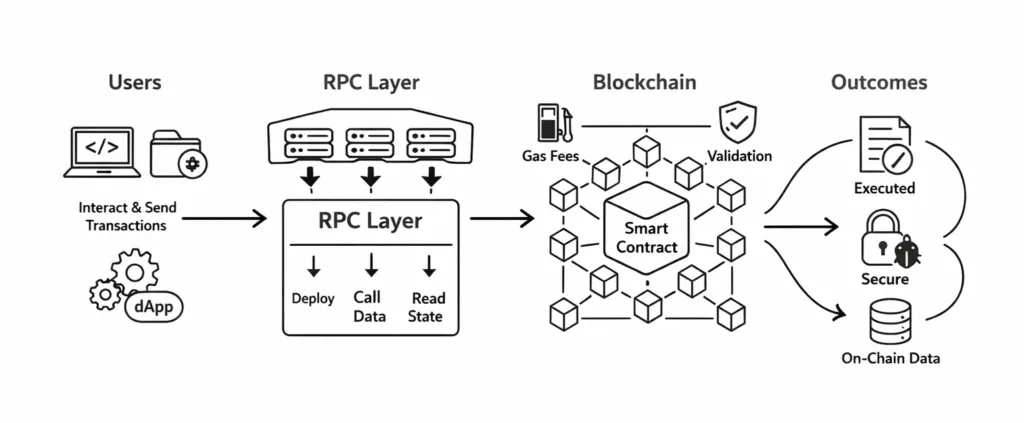
Smart contracts follow a predictable lifecycle across blockchains like Ethereum, Polygon, BNB Chain, and others:
1. Contract Development
Developers write smart contracts using languages such as:
Solidity (Ethereum-compatible chains)
Vyper (security-focused EVM alternative)
2. Deployment to a Network
Contracts are compiled and deployed via a transaction sent to the blockchain. This process:
Consumes gas fees
Stores contract bytecode on-chain
Assigns a permanent contract address
Deployment transactions are broadcast and validated by blockchain nodes.
3. Execution via Transactions
Users or applications interact with smart contracts by calling functions. These calls:
Trigger state changes (writes)
Or return on-chain data (reads)
Are processed by validators/miners
4. Interaction Through RPC Calls
Applications do not talk directly to blockchains. Instead, they rely on RPC endpoints to:
Submit transactions
Query smart contract state
Read logs and events
This RPC layer is critical for performance, reliability, and developer experience.
Key Features of Smart Contracts
Smart contracts introduce several properties that distinguish blockchain systems from traditional software:
Automation
Contracts execute automatically without human intervention once conditions are satisfied.
Trustless Operation
Participants do not need to trust each other—only the contract logic.
Transparency
All contract code and transactions are publicly verifiable on-chain.
Cryptographic Security
Blockchain consensus and cryptography secure execution and state integrity.
Immutability
Once deployed, contracts cannot be altered, reducing attack vectors but increasing the importance of audits.
These properties explain why smart contracts are foundational to Web3 systems.
Smart Contract Use Cases in Web3
Smart contracts power nearly every major Web3 vertical today:
DeFi (Decentralized Finance)
Automated lending and borrowing
Token swaps and liquidity pools
Yield farming and staking
NFTs
Minting and ownership verification
Royalties distribution
Marketplace logic
Gaming
On-chain asset ownership
Play-to-earn mechanics
Transparent in-game economies
DAOs
Governance voting
Treasury management
Proposal execution
Supply Chain & Enterprise
Asset tracking
Compliance automation
Settlement workflows
Many real-world examples demonstrate smart contracts moving beyond experimentation into production systems .
Popular Smart Contract Blockchains in 2025
Different blockchains optimize smart contracts for different needs:
Ethereum
The most established smart contract platform with the largest developer ecosystem and tooling support.
BNB Chain
Optimized for low fees and high throughput, popular for consumer-focused dApps.
Polygon
A Layer-2 scaling solution offering Ethereum compatibility with lower costs.
Solana
High-throughput blockchain designed for real-time applications.
Avalanche
Supports custom subnets and enterprise-grade configurations.
Each ecosystem relies on reliable RPC access to ensure smart contract interaction remains performant.
Developing and Deploying Smart Contracts
Modern smart contract development relies on a standardized toolchain:
Development Tools
Testing Environments
Local forks
Public testnets (e.g., Sepolia, BNB Testnet)
Deployment & Interaction
All deployments and interactions occur via RPC endpoints, which:
Broadcast transactions
Query contract state
Retrieve logs and receipts
This is where infrastructure reliability directly impacts developer velocity.
Challenges in Smart Contract Development
Despite their advantages, smart contracts introduce real challenges:
Bugs and vulnerabilities (immutable code increases risk)
High gas fees during network congestion
Scalability limitations on Layer-1 chains
RPC bottlenecks causing failed deployments or stalled reads
Many production issues stem not from contract logic itself, but from unreliable node infrastructure.
How dRPC Supports Smart Contract Blockchain Development
dRPC provides a decentralized, low-latency RPC infrastructure designed for developers building and operating smart contracts across chains.
Key benefits include:
Multi-chain RPC coverage for EVM and non-EVM networks
Decentralized provider routing to avoid single points of failure
Consistent performance during deployments, testing, and production traffic
By abstracting node management complexity, dRPC allows developers to focus on smart contract logic rather than infrastructure stability.
Developers can explore services at https://drpc.org/ or connect directly via supported endpoints.
FAQs
What are smart contracts in blockchain?
Smart contracts are self-executing programs stored on a blockchain that automatically enforce rules and agreements without intermediaries.
How do smart contracts execute on the blockchain?
They execute when transactions trigger their functions, with blockchain nodes validating and recording the results.
What are the best blockchains for smart contracts?
Ethereum, Polygon, BNB Chain, Solana, and Avalanche are among the most widely used platforms.
Are smart contracts safe?
They are secure by design but vulnerable to coding errors. Audits and testing are essential.
How do developers interact with smart contracts via RPC?
Applications use RPC endpoints to deploy contracts, submit transactions, and query on-chain state.
Take-Away
Smart contracts are the core automation layer of blockchain ecosystems. From DeFi and NFTs to DAOs and enterprise workflows, they enable trustless execution at global scale.
However, reliable smart contract interactions depend on robust infrastructure. Choosing stable, decentralized RPC endpoints ensures faster deployments, safer testing, and consistent production performance.
For developers building across multiple smart contract blockchains, dRPC provides the infrastructure layer that keeps Web3 applications responsive, resilient, and scalable.