

Introduction
As blockchain adoption moves beyond DeFi and NFTs into real-world payments, a new class of Layer-1 networks is emerging. These chains are not designed for speculation or experimental protocols, but for stablecoin settlement, compliance-aware infrastructure, and high-throughput financial workflows.
Tempo L1 sits firmly in this category.
Backed by industry heavyweights and quietly tested with global financial institutions, Tempo is positioning itself as a payments-first blockchain designed for banks, payment processors, and developers building real-world financial applications. For builders, that shift changes what matters most: predictable execution, reliable RPC connectivity, and infrastructure that behaves like production finance, not a beta experiment.
This article breaks down what makes Tempo L1 different, how it competes with other Layer-1s, and why institutions are paying attention. It applies a practical lens for developers who need dependable RPC access to build on Tempo today.
What Is Tempo L1?
Tempo is a Layer-1 blockchain purpose-built for stablecoin payments and financial settlement, rather than generalized smart-contract experimentation.
According to reporting from The Block and CryptoSlate, Tempo was introduced as a payments-focused blockchain incubated by Stripe and Paradigm, with early participation from global financial institutions. Unlike most L1s that retrofit financial use cases after launch, Tempo was designed from day one around payment flows, compliance needs, and enterprise-grade reliability.
At a high level, Tempo prioritizes:
Stablecoin-native transaction execution
High-throughput payment processing
Predictable finality and settlement guarantees
Infrastructure suitable for banks and payment processors
For developers, this means Tempo behaves less like a speculative DeFi chain and more like financial infrastructure you can depend on.
What Makes Tempo Different From Other Layer-1 Blockchains?
Most Layer-1 networks today fall into one of two categories:
General-purpose smart contract platforms (Ethereum, Solana, Polygon)
High-performance chains optimized for DeFi or consumer apps
Tempo deliberately avoids both extremes.
Payments-First Architecture
Tempo is optimized specifically for stablecoin payments, not for yield farming, memecoins, or experimental governance tokens. Industry coverage highlights Tempo’s focus on cross-border payments, B2B settlement, and on-chain financial workflows that mirror existing payment rails.
This design choice affects everything from execution flow to infrastructure requirements.
Predictability Over Maximum Throughput
While many L1s compete on raw TPS benchmarks, Tempo prioritizes:
Consistent latency
Deterministic execution
Controlled network behavior under load
For banks and payment processors, predictability matters more than peak performance — and Tempo is built accordingly.
Institutional-Grade Network Design
Tempo has been reported to run private and controlled testnets with regulated financial partners, rather than open, permissionless chaos from day one. This allows institutions to evaluate the network in environments that resemble real production systems.
Why Banks and Payment Processors Are Adopting Tempo
One of the most compelling signals around Tempo is who is testing it.
According to reporting from CryptoNews and The Block, Tempo has entered private testing phases with major financial institutions, including global payment networks and banks. These tests focus on real-world workloads like:
Stablecoin settlement
Cross-border payments
B2B transfers
Embedded payment flows
Why Institutions Care
Traditional financial players care about a very different set of properties than most crypto-native users:
Operational stability
Clear execution guarantees
Compliance-friendly infrastructure
Low-risk integration paths
Tempo’s architecture and go-to-market strategy align closely with these requirements, which explains why its early adoption is happening quietly — through pilots and private testing — rather than loud token launches.
How Tempo Competes With Other Layer-1s
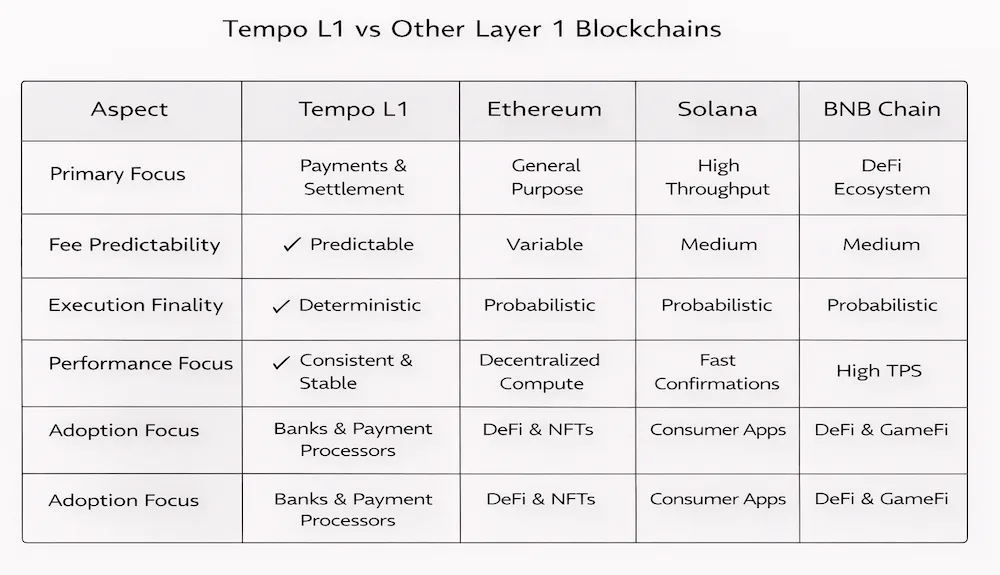
Tempo is not trying to replace Ethereum, Solana, or other general-purpose L1s. Instead, it competes in a much narrower but highly valuable segment: payments infrastructure.
Tempo vs Ethereum
Ethereum remains the most decentralized smart contract platform, but:
Transaction fees fluctuate unpredictably
Execution latency varies by network conditions
Payments are not a first-class design concern
Tempo trades some generality for payment-specific reliability, making it more attractive for institutions that cannot tolerate execution uncertainty.
Tempo vs Solana
Solana excels at high-throughput consumer applications, but has historically struggled with:
Network stability during peak usage
Complex validator operations
Outages that are unacceptable for regulated finance
Tempo focuses on controlled execution environments rather than maximal parallelism.
Tempo vs Private Blockchains
Private blockchains offer control but lack openness and developer ecosystems. Tempo positions itself between public and private systems: open enough for developers, structured enough for institutions.
Why RPC Infrastructure Matters More on Tempo Than Most Chains
If Tempo’s goal is real-world payments, then RPC reliability becomes mission-critical.
On speculative chains, a slow or unreliable RPC endpoint is an inconvenience. On a payments chain, it is a system failure.
Developers building on Tempo need:
Low-latency RPC access for transaction submission
Consistent responses for balance and state queries
High availability during peak settlement windows
Infrastructure that does not rate-limit production traffic unexpectedly
This is where Tempo L1 RPC connectivity becomes a core concern, not an afterthought.
Building on Tempo: Developer Experience and RPC Access
From a developer perspective, Tempo is designed to feel familiar while enforcing stricter guarantees around execution and state consistency.
Typical developer workflows include:
Submitting stablecoin transfers
Querying balances and transaction status
Integrating Tempo into payment backends
Monitoring settlement finality
All of these workflows depend on stable, production-grade RPC endpoints.
Why Developers Avoid Public RPCs in Payment Systems
Public RPC endpoints are fine for experimentation, but unsuitable for financial applications because they often introduce:
Rate limits
Shared capacity
Inconsistent latency
No SLA guarantees
For Tempo-based applications, developers need dedicated, professionally managed RPC infrastructure.
Using dRPC for Tempo L1 RPC Connectivity
To support builders working on Tempo, dRPC provides reliable RPC access to the Tempo testnet, designed for developers who need production-like behavior even in early stages.
Why dRPC Fits Tempo’s Design Philosophy
dRPC aligns closely with Tempo’s infrastructure goals:
Decentralized provider architecture
Stable routing across nodes
Low-latency global access
Infrastructure designed for real workloads
Instead of relying on a single RPC server, dRPC routes requests across distributed, independent providers, improving resilience and consistency.
Use Cases Developers Are Building on Tempo
Early Tempo builders are focused on practical applications, including:
Stablecoin payment gateways
On-chain settlement layers for fintech apps
Cross-border payout systems
Treasury management tools
All of these require infrastructure that behaves like finance, not like a hackathon demo.
Tempo and the Future of Blockchain Payments
Tempo reflects a broader shift in the blockchain ecosystem: the separation of financial infrastructure from speculative experimentation.
As more banks and payment processors enter Web3, the demand for chains like Tempo will grow — chains that:
Prioritize stability over hype
Offer predictable execution
Support enterprise-grade infrastructure
Treat RPC reliability as a first-class requirement
For developers, this creates a new opportunity: building applications that connect blockchain rails directly to real-world money movement.
Conclusion
Tempo L1 is not trying to be everything. It is trying to be one thing done extremely well: a blockchain optimized for payments.
Its adoption by banks and payment processors, as reported by leading crypto industry publications, signals growing demand for blockchain infrastructure that behaves like real financial systems. For developers, that means new opportunities — and new expectations around reliability.
If you’re building on Tempo, RPC connectivity is not optional infrastructure. It is foundational.
With dRPC’s Tempo testnet RPC endpoints, developers can build, test, and scale Tempo-based applications with the reliability that payments demand.