BNB Smart Chain (often called BSC) has become one of the most widely used blockchain networks in Web3. Known for its fast transaction times, low fees, and compatibility with Ethereum tooling, it powers thousands of decentralized applications, wallets, and DeFi protocols.
For users and developers alike, understanding how BNB Smart Chain works and how to properly set up a BNB Smart Chain wallet is essential. Wallet connectivity, RPC endpoints, and network configuration directly impact transaction reliability, speed, and overall user experience.
In this guide, we’ll explain what BNB Smart Chain is, how it works under the hood, and how to configure a wallet to connect to the network using stable, decentralized RPC infrastructure.
Understanding BNB Smart Chain (BSC)
BNB Smart Chain is a blockchain network developed to support smart contracts and decentralized applications while maintaining low transaction costs and high throughput. It evolved from the original Binance Chain, which focused primarily on fast asset transfers and trading.
To enable smart contracts, Binance introduced BNB Smart Chain as an EVM-compatible network. This decision allowed developers to reuse Ethereum-based tooling, smart contracts, and libraries without rewriting core logic.
Key characteristics of BNB Smart Chain include:
Full Ethereum Virtual Machine compatibility
Short block times and fast transaction finality
Low gas fees compared to Ethereum mainnet
Strong ecosystem of wallets, DeFi apps, and tools
Like other EVM-compatible networks, BSC relies on RPC endpoints to allow wallets and applications to read blockchain state and submit transactions. Without a stable RPC connection, even the best BNB Smart Chain wallet will struggle to function reliably.
You can verify transactions and blocks using the official explorer: https://bscscan.com/
How BNB Smart Chain Works
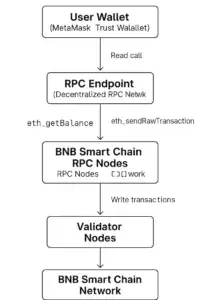
BNB Smart Chain operates using a dual-chain architecture alongside the original Binance Chain. While Binance Chain handles fast asset transfers and governance, BNB Smart Chain is responsible for smart contract execution and dApp logic.
Validators and consensus
BNB Smart Chain uses a Proof of Staked Authority (PoSA) consensus mechanism. A limited set of validators propose and validate blocks, enabling high throughput and predictable performance.
RPC nodes and wallet connectivity
When a user interacts with a BNB Smart Chain wallet, the wallet does not connect directly to validators. Instead, it communicates through RPC nodes, which:
Query balances and transaction history
Broadcast signed transactions
Fetch smart contract state
This is why RPC reliability is critical. If the RPC endpoint is slow, overloaded, or unavailable, wallet actions such as sending tokens or approving transactions may fail.
Using decentralized RPC infrastructure helps reduce downtime, latency, and single points of failure — especially during periods of high network activity.
Setting Up Your BNB Smart Chain Wallet
Setting up a BNB Smart Chain wallet is straightforward, especially if you already use an Ethereum-compatible wallet like MetaMask.
Add BNB Smart Chain to MetaMask
Open MetaMask and add a custom network with the following details:
Once saved, MetaMask will switch to BNB Smart Chain and allow you to send, receive, and interact with BSC-based dApps.
Using a decentralized RPC endpoint ensures:
You can connect to BNB Smart Chain using dRPC’s decentralized RPC endpoints here: https://drpc.org/chainlist/bsc-mainnet-rpc
Popular BNB Smart Chain Wallet Options
There are several wallet options available for BSC users, depending on platform and use case.
Browser-based and widely supported
Manual BSC network configuration required
Ideal for developers and DeFi users
All of these options rely on RPC endpoints behind the scenes. A reliable BNB Smart Chain wallet experience depends heavily on the quality of the RPC infrastructure used.
Why Use Decentralized RPC Endpoints for BNB Smart Chain
RPC endpoints act as the gateway between wallets, dApps, and the blockchain. Many default wallet configurations rely on centralized RPC providers, which can introduce problems such as:
Rate limiting
Regional outages
Slow response times
Single points of failure
Decentralized RPC providers like dRPC distribute requests across multiple independent nodes and regions, improving reliability and performance.
Benefits of using dRPC for BNB Smart Chain include:
Global low-latency routing
Decentralized infrastructure for higher uptime
Stable wallet and dApp connectivity
Easy integration for developers and users
This is especially important for applications that handle high transaction volumes or operate across multiple regions.
FAQs
What is BNB Smart Chain?
BNB Smart Chain is an EVM-compatible blockchain designed for fast, low-cost smart contract execution and decentralized applications.
How do I create a BNB Smart Chain wallet?
You can create a BNB Smart Chain wallet using MetaMask, Trust Wallet, or Binance Wallet and connect it via an RPC endpoint.
How do I connect MetaMask to BNB Smart Chain?
Add BNB Smart Chain as a custom network in MetaMask using the correct RPC URL, Chain ID, and explorer.
What is a BNB Smart Chain RPC endpoint?
An RPC endpoint is a gateway that allows wallets and dApps to interact with BNB Smart Chain nodes.
Is BNB Smart Chain compatible with Ethereum?
Yes. BNB Smart Chain is fully EVM-compatible, allowing Ethereum smart contracts and tools to be reused.
Conclusion
BNB Smart Chain has established itself as a major network for Web3 users and developers, offering fast transactions, low fees, and full EVM compatibility. However, a smooth experience depends not just on the network itself, but on how wallets and applications connect to it.
Choosing a reliable BNB Smart Chain wallet and pairing it with decentralized RPC infrastructure is essential for stable, secure blockchain access. By using decentralized RPC endpoints like those provided by dRPC, users and developers can avoid common connectivity issues and ensure consistent performance.
If you’re setting up a wallet or building on BSC, reliable RPC access should be part of your foundation — not an afterthought.
Connect to BNB Smart Chain using dRPC’s decentralized RPC endpoints.


![What Is BNB Smart Chain? [Introducing Network & Wallet]](https://drpc.org/blog/wp-content/uploads/2025/12/What-Is-BNB-Smart-Chain-Introducing-Network-Wallet-1024x576.webp)