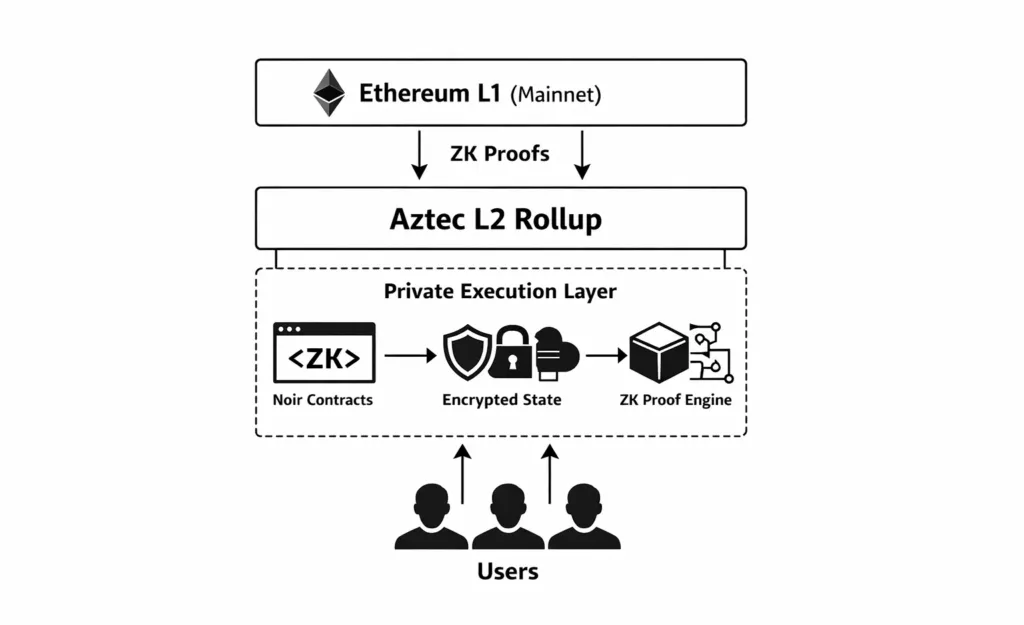
This architectural focus sets Aztec apart.
While chains like MegaETH (read our MegaETH Spotlight article) emphasize throughput and latency, Aztec emphasizes confidentiality and secure logic execution.
Likewise, compared to execution-focused ecosystems like DogeOS (read our DogeOS Spotlight article), Aztec’s core differentiator is encrypted computation.
Why Builders Should Pay Attention Now
Aztec is not simply a privacy coin or niche experiment. It represents a structural evolution in how smart contracts may operate in regulated or competitive environments.
Builders should explore Aztec if they are working on:
Private trading strategies
DAO voting systems with hidden ballots
Identity systems with selective disclosure
Enterprise DeFi integrations
On-chain gaming with hidden state
Privacy is not just about secrecy. It’s about competitive advantage.
The earlier developers experiment with Aztec network endpoints, the faster they can understand its programming model and performance profile.
Developer Experience: What to Expect
Aztec’s developer stack is different from standard Solidity workflows.
Builders interact with:
This requires a learning curve.
However, the opportunity is significant:
Privacy-native dApps may become foundational primitives for institutional Web3 adoption.
Accessing Aztec Network Endpoints with dRPC NodeCloud
To build on Aztec, developers need reliable Aztec network endpoints.
dRPC supports Aztec via NodeCloud, providing:
Public RPC endpoints
Managed, production-grade RPC routing
Support for both mainnet and testnet
Unified access alongside 180+ networks
Access Aztec network endpoints here –> https://drpc.org/chainlist/aztec-mainnet-rpc
NodeCloud provides:
AI-powered load balancing
Multi-provider routing
High availability architecture
Consistent performance under load
If your application relies on encrypted contract execution, low-latency access to Aztec network endpoints becomes critical for maintaining responsive UX.
Why Managed RPC Matters on Privacy Networks
Privacy networks introduce additional computational overhead:
A fragile RPC layer can quickly degrade user experience.
NodeCloud’s architecture ensures:
Learn more about NodeCloud.
Because Aztec is zk-heavy, infrastructure quality directly affects developer iteration speed.
Use Cases Emerging on Aztec
Although early, several themes are already forming:
Private DeFi
DAO Governance
Identity & Credentials
Enterprise Workflows
Aztec network endpoints will become the gateway for these new design patterns.
Aztec vs The Broader L2 Landscape
Ethereum L2 ecosystems now fall into distinct categories:
Aztec occupies a unique quadrant.
It doesn’t compete directly on TPS marketing metrics.
It competes on cryptographic design philosophy.
If Ethereum is programmable money, Aztec aims to make it programmable privacy.
Risks and Considerations
No Chain Spotlight is complete without balance.
Aztec developers must consider:
Tooling maturity
Ecosystem size
Learning curve of Noir
Performance tradeoffs
Privacy systems inherently introduce complexity.
But complexity also creates moat.
The Strategic Timing
Aztec is entering the market during a broader:
These conditions make confidentiality infrastructure increasingly attractive.
Builders experimenting today may gain:
And reliable Aztec network endpoints ensure infrastructure does not become the limiting factor.
How Aztec Network Endpoints Fit into Multi-Chain Strategy
Many dApps today are multi-chain by design. In a multi-chain environment, stable and low-latency Aztec endpoints ensure privacy-enabled applications perform consistently alongside public execution layers.
Using NodeCloud, developers can:
Access Aztec network endpoints
Maintain consistent RPC interfaces
Route traffic intelligently
Monitor performance across chains
All under one unified RPC layer.
This reduces operational complexity.
Take Away
Aztec Network represents one of the most intellectually ambitious efforts in the Ethereum L2 space.
It does not chase throughput headlines.
It redefines smart contract confidentiality.
For builders serious about privacy as a feature, not an afterthought, Aztec is worth exploring.
And with Aztec network endpoints available via dRPC NodeCloud for both mainnet and testnet, there is no infrastructure barrier to getting started.
The next wave of Web3 innovation may not be faster.
It may simply be more private.
Other Ecosystems
If you want to explore other emerging ecosystems, check out:
MegaETH Spotlight: https://drpc.org/blog/megaeth-rpc-endpoints/
DogeOS Spotlight: https://drpc.org/blog/dogeos-rpc-infrastructure/
Privacy, execution, and throughput — each chain tells a different story.
FAQs
1. What are Aztec endpoints?
Aztec network endpoints are RPC interfaces that allow developers to interact with the Aztec Network. They enable dApps to submit transactions, query state, deploy contracts, and interact with privacy-enabled smart contracts on both Aztec mainnet and testnet.
2. How is Aztec different from other Ethereum Layer 2 networks?
Unlike most Layer 2 solutions that prioritize throughput and lower gas fees, Aztec focuses on programmable privacy. It enables encrypted smart contract execution using zero-knowledge proofs, allowing developers to build confidential applications while still inheriting Ethereum’s security.
3. Why would developers need privacy-enabled smart contracts?
Privacy-enabled contracts are useful for:
Private DeFi strategies
Anonymous DAO voting
Confidential business logic
zk-based identity systems
Enterprise integrations requiring selective disclosure
Aztec allows developers to define what data is provable versus what remains hidden.
4. Do Aztec network endpoints support both mainnet and testnet?
Yes. Developers can access Aztec network endpoints for both mainnet and testnet via dRPC NodeCloud. This allows teams to test, iterate, and deploy confidential applications without managing their own RPC infrastructure.
Access here: https://drpc.org/chainlist/aztec-mainnet-rpc
5. What programming language does Aztec use?
Aztec uses Noir, a domain-specific language designed for writing zero-knowledge circuits. Noir allows developers to define privacy logic directly within smart contract workflows.
6. Is Aztec compatible with Solidity?
Aztec introduces a different execution model centered around privacy and zk proofs. While it is Ethereum-aligned and posts proofs to Ethereum, development workflows differ from traditional Solidity-based contracts due to encrypted state and zk circuit design.
7. Why is reliable RPC infrastructure important for Aztec?
Privacy networks involve proof generation and encrypted state handling, which increase computational complexity. Unstable RPC endpoints can degrade user experience. Managed solutions like NodeCloud ensure high availability, health-aware routing, and multi-provider redundancy.
8. Can Aztec be part of a multi-chain strategy?
Yes. Many teams are adopting multi-chain architectures. Using a managed RPC layer like NodeCloud allows developers to access Aztec network endpoints alongside 180+ other networks through a unified interface, simplifying operations and monitoring.
9. Is Aztec production-ready?
Aztec is evolving rapidly, with increasing developer interest and ecosystem activity. As with any emerging L2, teams should evaluate tooling maturity, ecosystem size, and performance requirements before deploying mission-critical applications.
10. Who should consider building on Aztec?
Aztec is especially suited for:
Privacy-focused DeFi protocols
Confidential DAO governance systems
zk identity projects
Enterprise Web3 integrations
Builders exploring programmable confidentiality
If privacy is a core product feature rather than an optional add-on, Aztec is worth serious consideration.