

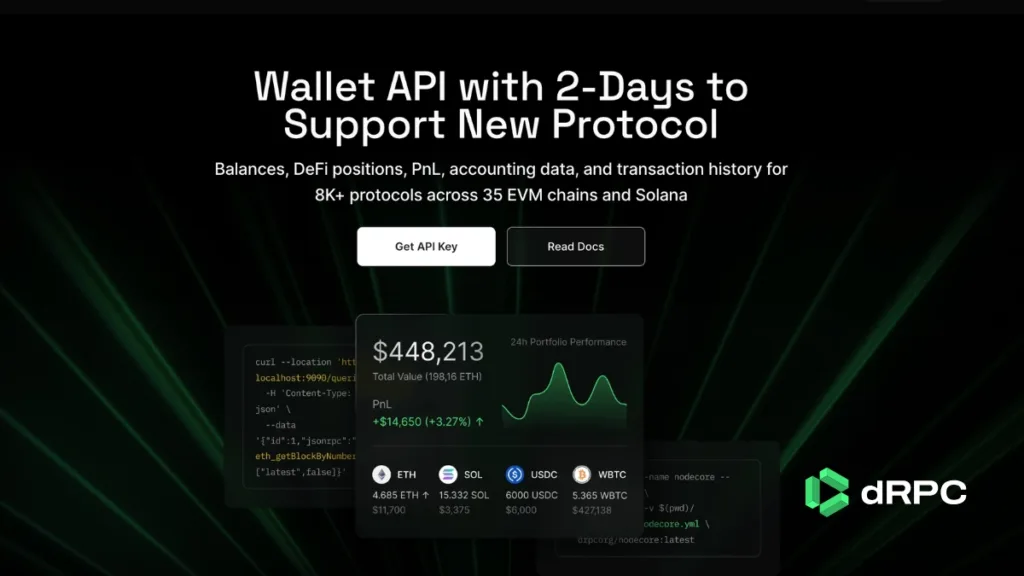
The dRPC Data API is a crypto wallet API that returns wallet balances, DeFi positions, transaction history, and historical PnL across 8,000+ protocols, 35+ EVM chains, and Solana from a single REST endpoint. It removes the indexing layer most teams build themselves, so you query high-level portfolio data directly instead of parsing logs and running your own databases.
If you are already on a paid dRPC plan, it is live in your existing API keys today.
Why raw RPC is not enough for wallet data
Standard RPC nodes are built to broadcast transactions and read chain state. They are not built to answer “what does this wallet hold right now, across every chain, with USD values and spam filtered out.”
To get that, teams usually build a custom indexing stack: subgraphs, databases, log parsers, and price feeds. It takes months, costs real money in server time, and breaks when a node desyncs. A crypto wallet API removes that work by serving the aggregated, decoded result instead of the raw inputs.
What you can build with the dRPC Data API
A wallet balance API call returns structured JSON, so you ship features instead of maintaining infrastructure:
- Unified wallets and portfolios. Real-time balances and prices across 35+ EVM chains and Solana in one call. Spam tokens are filtered out by default.
- DeFi portfolio tracking. Position-level data for 8,000+ protocols, covering supply, borrow, LP tokens, staking, and rewards.
- Transaction history. Decoded, human-readable transfers and contract interactions instead of raw hex.
- Tax and accounting. Historical PnL, cost-basis data, and reward breakdowns.
How this crypto wallet API is different
There are other indexed data APIs. Two gaps separate most of them from production needs: how fast coverage expands, and how fresh the data is.
CONCERN
COMMON PROVIDERS
dRPC DATA API
New DeFi protocol added
Weeks, on the provider’s roadmap
2 days on request
New EVM chain added
Variable, often months
5 days
DeFi position freshness
Cached on a timer
Transaction-triggered cache
Reliability
Best effort-uptime
99.9% compensated uptime SLA
Coverage
Single ecosystem common
35+ EVM chains plus Solana
Coverage that keeps up with DeFi
Web3 moves faster than most API roadmaps. If you need a protocol that is not yet covered, you submit a request and it is live in 48 hours. A new EVM chain takes 5 days. Your integration code does not change; the backend scales behind it.
Real-time data, not a stale cache
Many providers refresh DeFi positions on a timer. A user can close an Aave position and still see it as active in your app hours later. The dRPC Data API uses a transaction-triggered cache that updates the moment an on-chain transaction settles, so users see current positions rather than an old snapshot.
An SLA that is backed financially
Production workloads run under a 99.9% uptime SLA. If dRPC misses it, you are compensated.
Make your first request
There is no separate onboarding. If you are on a paid dRPC plan, the Data API is already active on your keys.
- Log into your dashboard, open an active API key, and copy the base URL from the Data API card. It follows the pattern
https://lb.drpc.live/lambda/<YOUR_API_TOKEN>. - Pull balances for a wallet. Example using vitalik.eth on Ethereum:
curl "https://lb.drpc.live/lambda/<YOUR_API_TOKEN>/ethereum/balances?address=vitalik.eth"
- You receive a structured array with total net worth, USD values, balances, and token metadata.
To query every supported network at once, remove ethereum/ from the path to hit the global endpoint.
Example shapes above are illustrative. Confirm exact paths and response fields against the live quickstart docs before publishing.
Frequently asked questions
What is a crypto wallet API? A crypto wallet API returns wallet-level data such as token balances, DeFi positions, transaction history, and portfolio value through a single interface, instead of requiring you to index and decode raw chain data yourself.
Which chains does the dRPC Data API support? 35+ EVM chains and Solana, with new EVM chains added in about 5 days on request.
How many DeFi protocols are covered? Over 8,000, with new protocols added within 48 hours of a request.
How fresh is the DeFi position data? The cache is transaction-triggered, so positions update when an on-chain transaction settles rather than on a fixed timer.
Do I need a new account to use it? No. If you are on a paid dRPC plan, the Data API is already live in your existing keys.
Get started
Your engineers should be writing product logic, not maintaining indexers. If you have a dRPC account, the Data API is sitting in your active keys.
- Go to your dashboard to get your endpoint
- Read the quickstart docs
- Learn more at drpc.org/data-api