

MegaETH Mainnet Launch: What Builders Need to Know
The Web3 world is buzzing today with the official launch of MegaETH mainnet, an ambitious new Ethereum Layer 2 (L2) chain positioned as a real-time blockchain built for extreme throughput and minimal latency. With MegaEth RPC endpoints available from launch, developers can immediately deploy, test, and monitor applications without waiting on infrastructure.
MegaETH went live on February 9, 2026, aiming to upend expectations for what an Ethereum scaling solution can deliver, with speed claims up to 100,000+ transactions per second (TPS) and sub-second responsiveness.
In this post we’ll unpack:
What MegaETH is and why it matters
How MegaETH compares to other L2s
Why builders should take notice now
Practical guidance for developers, including RPC and tooling support from dRPC
What Is MegaETH and Why It’s Turning Heads
MegaETH describes itself as the first real-time blockchain for Ethereum. It prioritises execution speed, near-instant finality, and developer UX without sacrificing security guarantees inherited from Ethereum’s mainnet.
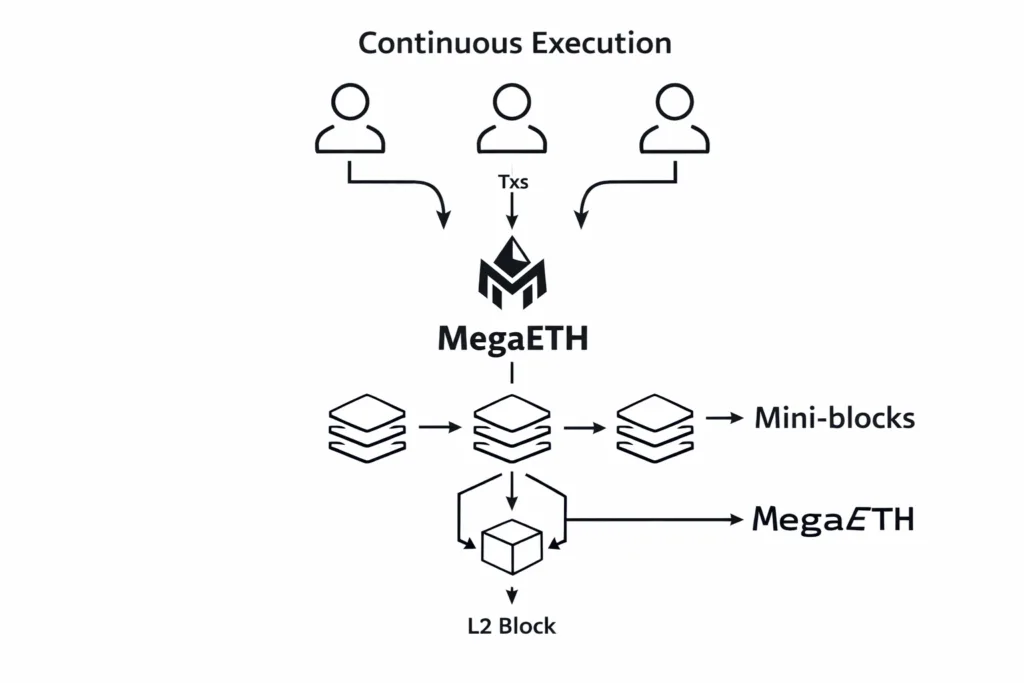
Rather than operating in large, periodic blocks like most chains, MegaETH processes transactions continuously and uses an execution model designed to deliver:
Ultra-low latency: Millisecond-level responsiveness for state updates
High throughput: Over 50,000 TPS observed in tests and theoretical targets exceeding 100,000 TPS
Optimised experience: Developers write familiar Ethereum smart contracts, with Solidity, standard tooling, EVM compatibility
This makes MegaETH more than just a faster rollup. It’s a next-generation application execution environment tailored for builders who need responsiveness similar to traditional web apps but within a secure blockchain context.
A Milestone Launch and Performance Stress Test
MegaETH’s mainnet debut followed extensive stress testing that pushed its limits under sustained load. Engineers and early partners ran weeks of real-world usage tests that handled billions of onchain transactions and maintained throughput that eclipsed what many blockchains achieve in years.
More than 50 applications were already live on launch day, spanning DeFi, NFTs, games, wallets, and tooling, reflecting a vibrant ecosystem ready to build on top of this high-performance layer.
Interestingly, the network’s native token (MEGA) is not being unlocked immediately. Its later distribution is tied to concrete network performance and usage milestones (such as active applications and stablecoin volume), demonstrating a focus on sustainability over speculation.
Why Developers Should Pay Attention Now
MegaETH’s approach solves several of the most persistent pain points for Web3 dApps:
1. Latency for Interactive Use Cases
Traditional rollups and L1s often have block-focused latency that feels slow for interactive apps like games, DeFi UIs, or live markets. MegaETH’s continuous execution model aims to erase that delay.
2. Throughput for Scale
High TPS means applications can scale without sudden congestion, improving outcomes for:
real-time finance apps
prediction markets
high-frequency trading dApps
immersive user experiences
3. EVM Compatibility
Existing Ethereum tooling, frameworks, wallets, and developer tools work on MegaETH, reducing onboarding friction.
4. Early Access Advantage
Builders who deploy earlier can:
Secure initial user traffic
Influence ecosystem standards
Integrate before network effects solidify elsewhere
Whether you’re building DeFi, gaming, cross-chain apps, or middleware, MegaETH represents a cutting-edge runtime environment that prioritises developer performance.
For developers evaluating the ecosystem, access to reliable MegaEth RPC endpoints is a prerequisite for testing contracts, syncing state, and operating production-grade applications.
Practical Building Blocks: Supported Tooling & Ecosystem
To build effectively on MegaETH today, you need robust infrastructure, especially for testing, querying state, and submitting transactions at high throughput.
RPC Endpoints and Why They Matter
RPC endpoints are critical for reliable communication between your applications and the MegaETH network. They serve as the backbone for state queries, transaction broadcasting, and dApp data access.
For a thorough explanation of how RPC endpoints and nodes work in blockchain development, see What Are RPC Nodes and Endpoints? A Complete Guide.
dRPC Support for MegaETH Builders
dRPC has announced support for free and paid RPC endpoints for MegaETH since its mainnet launch, providing developers with a reliable pipeline for:
sending transactions
querying balances and state
indexing logs
handling high-throughput workloads
Because MegaETH can generate massive bursts of requests, relying on a resilient RPC provider avoids common pitfalls such as stale state, rate limits, and timeouts.
From day one, dRPC provides both free and commercial-grade MegaEth RPC endpoints, allowing developers to start building immediately without running their own infrastructure.
NodeCloud: Managed RPC for MegaETH and 180+ Networks
For many teams, managing RPC infrastructure in-house isn’t feasible, especially for global, frontend-centric traffic. That’s where dRPC’s NodeCloud comes in.
NodeCloud provides:
Managed global RPC access for MegaETH
Multi-region endpoints
Intelligent load balancing
Failover and high availability
…all without you having to operate servers or maintain DevOps rigs.
With NodeCloud, Web3 apps can connect to MegaETH (and 180+ other chains) via production-grade endpoints engineered for uptime and performance.
These MegaEth RPC endpoints are served through dRPC NodeCloud, ensuring low latency, high availability, and consistent performance during early ecosystem growth.
👉 Start with MegaETH RPC via NodeCloud if you want plug-and-play to global infrastructure.