

![What Is a Smart Contract Wallet and How To Use It [Complete Guide]](https://drpc.org/blog/wp-content/uploads/2025/11/What-Is-a-Smart-Contract-Wallet-and-How-To-Use-It-Complete-Guide-dRPC-1024x576.webp)
Introduction
A smart contract wallet is a new breed of blockchain wallet that uses on-chain logic instead of relying solely on a single private key. It’s a programmable, flexible, and more secure alternative to traditional wallets like MetaMask.
These wallets are rapidly gaining traction in Web3 and DeFi ecosystems because they enable social recovery, gas abstraction, and multi-signature authorization — all managed through smart contracts.
In this complete guide, you’ll learn what smart contract wallets are, how they work under the hood, their pros and cons, and how to set one up and use it safely with decentralized RPC infrastructure such as dRPC.
What Is a Smart Contract Wallet?
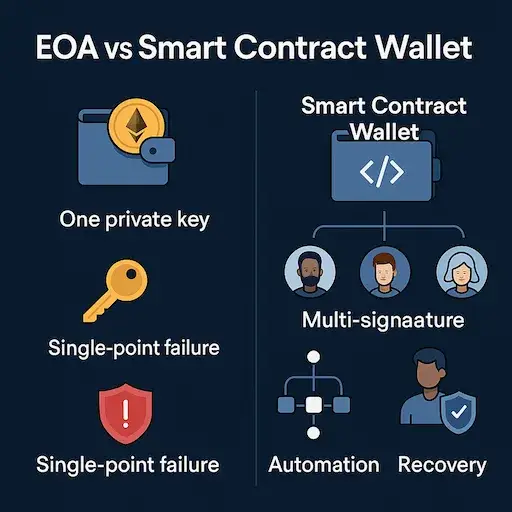
A smart contract wallet is a blockchain wallet controlled by smart contract code instead of a single private key. That means your wallet’s rules — who can approve a transaction, when funds can move, or how recovery happens — are enforced automatically by on-chain code.
In contrast, a traditional EOA (Externally Owned Account) depends entirely on one private key. Lose that key, and your assets are gone forever.
EOA vs Smart Contract Wallet
FEATURE
EOA WALLET (e.g. Metamask)
SMART CONTRACT WALLET (e.g. Safe, Argent)
Control
One private key
On-chain programmable logic
Recovery
None (seed phrase only)
Social or guardian recovery options
Gas fees
Paid by user
Can be automated or sponsored
Security
Single-key vulnerability
Multi-sig or policy-based verification
Logic updates
Impossible
Can upgrade via contract versioning
The Role of Account Abstraction
Account abstraction (AA) lets smart contracts behave like user accounts. It merges the logic of EOAs and contract accounts so wallets can sign, pay gas, batch transactions, and set validation rules directly in code.
EIP-4337 (Ethereum’s standard for AA) powers most modern smart contract wallets. It introduces UserOperations and bundlers, which process wallet actions without depending on centralized relayers.
Examples:
Argent → known for social recovery and gasless DeFi actions.
Safe → a DAO-grade multi-sig wallet standard.
ZeroDev → a developer SDK for integrating smart accounts.
How Does a Smart Contract Wallet Work?
A smart contract wallet is essentially a deployed contract on the blockchain that owns itself. Instead of “signing” every transaction with a key, users or guardians call contract functions that validate and execute actions based on programmable conditions.
Workflow Overview
The wallet contract is deployed on-chain and assigned an owner or set of owners.
The contract defines authorization logic — for example, requiring two of three signatures.
The user interacts through a front-end (like Safe App or a dApp).
The transaction request is sent via an RPC endpoint to a blockchain node.
The node validates, executes the contract logic, and broadcasts the transaction.
Here’s an example of a simplified transaction validation flow:
					function executeTransaction(address to, uint value, bytes calldata data) external {
    require(isAuthorized(msg.sender), "Not authorized");
    (bool success, ) = to.call{value: value}(data);
    require(success, "Tx failed");
}
This contract ensures only whitelisted addresses can trigger transfers — an upgrade over raw private-key signing.
Programmable Features and Logic Layers
Smart contract wallets introduce modular capabilities developers can build on:
Multi-sig authorization: Require multiple approvals before sending funds.
Social recovery: Trusted “guardians” can re-assign wallet ownership if access is lost.
Session keys: Grant limited temporary permissions (useful for games and DeFi bots).
Gas sponsorship: A third party (relayer) pays gas fees for smoother UX.
Spending policies: Daily limits, whitelists, or time-locks prevent misuse.
Batch operations: Execute multiple DeFi actions in one call, saving gas.
Each of these capabilities relies on RPC transactions to communicate with the blockchain.
Using a decentralized RPC provider like dRPC guarantees those calls reach live nodes even under network congestion or outages.
Benefits of Using Smart Contract Wallets
Smart contract wallets solve real pain points that developers and users face daily. Here’s why they’re quickly becoming the default Web3 standard.
1. Security by Design
Smart contract wallets eliminate the single-key vulnerability. You can require multiple signatures, time-delayed approvals, or custom validation logic. Even if one key is compromised, the attacker can’t drain funds without meeting the on-chain conditions.
2. Social Recovery and Key Flexibility
Forget the stress of 12-word seed phrases. Users can assign guardians (friends, devices, or institutions) who can collectively recover access. The logic is transparent on-chain — no centralized recovery service needed.
3. Automation for DeFi
Developers can script on-chain actions like auto-staking, yield rebalancing, or subscription payments. These automations execute through the wallet contract itself, often triggered by scheduled bots that send RPC calls to the blockchain.
4. Cross-Chain Compatibility
Most leading smart contract wallets now support multiple EVM chains (Ethereum, Polygon, Base, Arbitrum, etc.).
Through dRPC’s unified Chainlist endpoints, users can connect seamlessly across 180+ networks with one consistent API.
5. Gas Abstraction and UX Improvements
Smart wallets can sponsor gas for users that enables true gasless transactions or stablecoin-denominated gas. For non-technical users, this feels closer to Web2: sign in once, transact instantly, no crypto balance required for gas.
6. Auditability and Transparency
Since logic lives on-chain, anyone can verify how transactions are processed. Audited code from trusted frameworks like SafeCore ensures composable, secure functionality.
7. Developer Customization
Smart contract wallets are composable infrastructure — developers can plug in new modules, recovery rules, or analytics features without rebuilding the entire stack.
In short: smart contract wallets combine security, automation, and usability — three pillars that traditional wallets can’t match.
Limitations and Risks
Despite their power, these wallets also come with trade-offs:
Gas Costs – Deploying and executing contract logic costs more than an EOA transaction.
Code Complexity – Bugs or unverified contracts can expose funds; always use audited frameworks.
Infrastructure Dependence – If your RPC or bundler fails, you might experience temporary delays.
Standardization Gaps – Different chains implement account abstraction differently, causing inconsistencies.
That’s why infrastructure resilience matters. A decentralized RPC provider like dRPC mitigates these weaknesses by distributing requests across independent node operators in multiple regions. Even if one cluster experiences latency, your wallet calls are instantly rerouted elsewhere.
How To Set Up and Use a Smart Contract Wallet (Step-by-Step Guide)
Step 1: Choose a Smart Contract Wallet Platform
Top options:
Ready (formerly Argent) – Consumer-friendly wallet with guardian recovery and gasless swaps.
Safe (Gnosis) – Institutional-grade multi-sig wallet for teams and DAOs.
Ambire Wallet – DeFi-focused, supports automatic gas payments and batching.
Soul Wallet – Account-abstraction-ready with session keys.
Consider factors like chain support, mobile vs. web app availability, and security audits.
Step 2: Connect via a Decentralized RPC Endpoint
To interact with or deploy your wallet contract, connect to a decentralized RPC:
					import { ethers } from "ethers";
const provider = new ethers.JsonRpcProvider("https://lb.drpc.live/eth");
This ensures your connection to Ethereum (or any supported chain) remains live and uncensored.
Step 3: Deploy or Access the Wallet Contract
You can deploy a wallet through a factory contract:
					const walletFactory = new ethers.Contract(factoryAddress, factoryABI, signer);
const tx = await walletFactory.createWallet([owner1, owner2], 2);
await tx.wait();
Once deployed, the contract’s address becomes your wallet — ready to receive assets, interact with dApps, or execute multi-sig approvals.
Step 4: Manage and Authorize Transactions
Smart contract wallets validate transactions through on-chain logic before submission:
					const wallet = new ethers.Contract(walletAddress, walletABI, signer);
const tx = await wallet.executeTransaction(
  tokenAddress,
  0,
  tokenInterface.encodeFunctionData("transfer", [recipient, amount])
);
await tx.wait();
With dRPC’s geo-distributed infrastructure, your transactions broadcast reliably even during network spikes.
Step 5: Recover and Maintain Your Wallet
If you lose access, initiate social recovery through your guardians:
Each guardian approves the recovery request.
Once quorum is met, the wallet contract automatically updates ownership.
Since recovery is an on-chain process, it depends on RPC availability — another reason decentralized providers like dRPC are essential.
Smart Contract Wallet vs. Traditional Wallet
FEATURE
SMART CONTRACT WALLET
TRADITIONAL (EOA) WALLET
Security
Programmable, on-chain rules
One private key only
Recovery
Guardian-based
None
Automation
Built-in scripting
Manual
Cost
Higher gas per deploy
Lower per transaction
UX
Abstracted, user-friendly
Technical
Multichain
Yes
Usually limited
RPC Resilience
High (via decentralized RPC)
Variable, centralized
Why Use dRPC with Smart Contract Wallets
For any smart contract wallet, RPC connectivity is the invisible backbone. Without a robust RPC layer, even the best wallet logic can fail to broadcast or confirm transactions.
1. Global Reliability
dRPC aggregates dozens of independent node providers across regions, offering automatic failover and adaptive routing. This means your wallet transactions — from guardian approvals to DeFi swaps — continue working even if one provider goes offline.
2. True Decentralization
Unlike centralized RPC providers that can throttle traffic or block addresses, dRPC operates a permissioned yet distributed node pool. Each cluster verifies uptime and consensus accuracy, ensuring censorship-resistant connectivity.
3. Low Latency Performance
By using edge load balancing and nine geographic clusters, dRPC reduces average latency by up to 40 %. That translates to faster transaction confirmations and more responsive wallet UIs.
4. Multi-Chain Coverage
Developers and users can access 180 + networks — Ethereum, Polygon, Arbitrum, Base, Cronos, and more — through a single domain:
👉 https://lb.drpc.live
This unified access simplifies integration for wallets supporting multiple ecosystems.
5. Developer-First Design
dRPC supports standard JSON-RPC, WebSocket, and HTTP connections compatible with Web3.js, Ethers.js, and WalletConnect. It’s plug-and-play for any smart contract wallet SDK.
Bottom line: connecting via decentralized RPC isn’t optional for mission-critical wallets — it’s the foundation of uptime, security, and scalability.
🔗 Connect your smart contract wallet using dRPC for maximum reliability and global reach.
FAQs
What is a smart contract wallet in Web3?
A smart contract wallet is an on-chain wallet managed by programmable code instead of a single private key. It enables automation, multi-sig, and social recovery.
How is a smart contract wallet different from MetaMask?
MetaMask is an EOA wallet controlled by one key. Smart contract wallets use code logic, allowing multiple signers, recovery rules, and gas sponsorship.
Are smart contract wallets safe to use?
Yes — if audited and used with decentralized RPCs like dRPC. They remove the human error risk of key loss and ensure consistent uptime.
How can I connect my smart contract wallet to the blockchain?
Use a Web3 library such as Ethers.js and connect to a decentralized RPC endpoint (https://lb.drpc.live/eth) to broadcast and verify transactions.
What are the best RPC providers for smart contract wallets?
Decentralized networks like dRPC offer high uptime, fast responses, and censorship-resistant connectivity — ideal for both developers and users
Conclusion
Smart contract wallets are redefining user experience in Web3. They merge security, automation, and accessibility, bringing the blockchain one step closer to mainstream adoption.
For developers, they open a playground of programmable logic — from gasless onboarding to custom recovery flows. For users, they offer peace of mind and smoother UX.
Yet their reliability hinges on one crucial layer: RPC infrastructure.
A decentralized RPC network like dRPC ensures your wallet transactions, recoveries, and DeFi interactions execute without delay or downtime.
Start building smarter with dRPC today.
→ Explore decentralized RPC endpoints for Ethereum and Polygon