

Introduction
Every blockchain dApp — from a simple wallet to a multi-chain exchange — depends on one protocol to communicate with nodes: JSON-RPC. It is lightweight, fast, language-agnostic, and standardized across nearly every major blockchain ecosystem.
Whether you’re fetching a balance, executing a contract call, or broadcasting a transaction, JSON-RPC is the interface doing the work. Understanding what JSON-RPC is, how it works, and why it powers virtually every Web3 stack is essential for developers, DevOps engineers, and CTOs architecting scalable blockchain systems.
In this guide, you’ll learn how JSON-RPC enables dApps to interact with nodes, how its standardization simplifies cross-chain development, and why decentralized RPC networks like dRPC rely on JSON-RPC to deliver high-speed, reliable blockchain infrastructure.
Understanding JSON-RPC
Definition
JSON-RPC is a stateless, lightweight remote procedure call protocol that uses JSON for encoding requests and responses. It allows one system (e.g., a dApp) to execute methods on another system (e.g., a blockchain node).
Key Characteristics
Stateless — each request contains all required information
Lightweight — uses simple request/response JSON objects
For developers building dApps, this predictable request–response pattern is one of the main reasons JSON-RPC is so widely adopted across chains.
Transport-agnostic — works over HTTP or WebSocket
Language-agnostic — any programming language can implement it
Minimal overhead — perfect for real-time blockchain data
Unlike REST APIs — which rely on resource-based URLs — JSON-RPC calls methods directly.
This is a core reason why nearly all blockchain networks use JSON-RPC interfaces.
These characteristics are exactly why JSON-RPC became the default communication protocol for nearly every modern blockchain network.
How JSON-RPC Works in Blockchain
Every Ethereum-compatible node (and most other networks) exposes a JSON-RPC interface. dApps connect to this interface through RPC endpoints.
How Requests Flow
The dApp calls a JSON-RPC method (e.g., eth_getBalance).
The request is sent to the node via HTTP or WebSocket.
The node executes the method and returns the result.
The dApp parses the response and updates its UI or backend logic.
Typical Use Cases
JSON-RPC powers critical operations:
Reading smart contract state
Fetching account balances
Getting block data
Retrieving logs/events
Submitting signed transactions
Estimating gas
Every time your app shows a user’s token balance, JSON-RPC is involved.
Example JSON-RPC Request
					{
  "jsonrpc": "2.0",
  "method": "eth_getBalance",
  "params": ["0x1234...", "latest"],
  "id": 1
}
Example JSON-RPC Response
					{
  "jsonrpc": "2.0",
  "id": 1,
  "result": "0x56bc75e2d63100000"
}
JSON-RPC’s structure — small, predictable, and method-based — is exactly why developers depend on it to power dApps at scale.
Key Features of JSON-RPC
Lightweight and Fast
JSON-RPC has minimal processing overhead, allowing dApps to poll frequently and fetch real-time data efficiently.
Standardized Across Chains
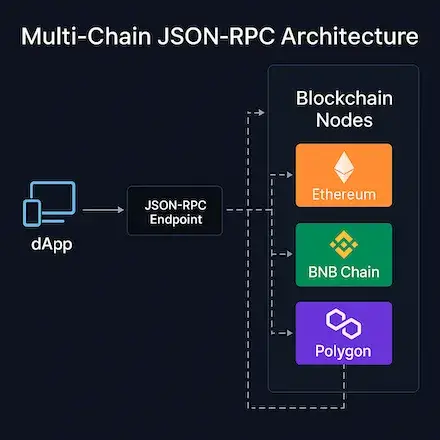
Ethereum, Polygon, BNB Chain, Avalanche, Base, Optimism, Arbitrum, Cronos — all implement nearly the same JSON-RPC method set.
This makes cross-chain development dramatically easier.
Human-Readable JSON
Everything is encoded in JSON:
easy to debug
easy to log
easy to inspect in development tools
Works on HTTP & WebSocket
HTTP for one-off queries
WebSocket for event subscriptions (e.g., new blocks)
Supported by Every Web3 Library
Including:
Web3.js
Ethers.js
Viem
Web3.py
Wagmi
Hardhat & Foundry
GraphQL indexers
JSON-RPC is the universal language of blockchain development.
More references:
Ethereum JSON-RPC API
Web3.js Documentation
RPC vs API: Why JSON-RPC Is the Blockchain API
Traditional APIs (REST, GraphQL) are built around resources, not methods. In contrast, blockchains require:
exact node state
deterministic method calls
high-frequency queries
standardized call signatures
JSON-RPC excels here because:
FEATURE
JSON-RPC
REST API
Format
Method-based
Resource-based
Latency
Low
Higher
Blockchain native?
Yes
No
Real-time support
WebSocket RPC
Requires SSE or custom WS
Standard across chains
Yes
No
Use case
Smart contracts, logs, blocks
Aggregated or curated data
This is why nearly all Web3 infrastructure — nodes, wallets, explorers, DeFi apps — is built around JSON-RPC.
Why JSON-RPC Is Essential for Blockchain dApps
At scale, JSON-RPC becomes the backbone of how decentralized applications fetch real-time state, interact with smart contracts, and broadcast transactions.
Low-Latency Access to Live Chain Data
dApps must respond quickly to changes on-chain. JSON-RPC is optimized for:
fast state reads
efficient block polling
low-overhead computations
Consistency Across Chains
Standardization is one of JSON-RPC’s biggest strengths:
same method names
same request structures
same behaviors
Developers reuse code easily across multiple ecosystems.
Ideal for Smart Contract Interaction
Smart contracts expose functions through eth_call, eth_sendRawTransaction, eth_estimateGas, and other JSON-RPC methods.
No traditional API can replicate this precision.
Supports Both HTTP & WebSocket RPC
HTTP → one-time data queries
WebSocket → subscriptions to live events
This dual support makes JSON-RPC incredibly flexible.
Designed for High-Frequency Queries
DeFi platforms, wallets, and trading bots may call JSON-RPC thousands of times per minute.
It is built for this load.
Standard JSON-RPC Implementation Across Chains
JSON-RPC is the default interface for nearly all L1 and L2 networks.
Examples
Ethereum / EVM chains
Use standardized method sets (EIP-1474, EIP-1767).
BNB Chain
Fully JSON-RPC compatible.
Polygon, Avalanche, Fantom
All JSON-RPC native.
L2 networks (Base, Optimism, Arbitrum)
Extend JSON-RPC with specific rollup methods.
Why Standardization Matters
Cross-chain portability — same code works everywhere
Reduced developer friction
Shared tooling ecosystem
Predictable behavior
Lower maintenance overhead
This is why JSON-RPC is the backbone of multi-chain dApp development.
How dRPC Provides Standard JSON-RPC Endpoints
dRPC delivers decentralized, high-speed JSON-RPC endpoints for 180+ networks. Developers rely on dRPC because:
Decentralized Node Infrastructure
Multiple independent node providers ensure:
higher uptime
reduced failure risk
more stable performance
High-Performance Global Routing
dRPC uses geo-routing + load balancing to minimize latency.
Multi-Chain Support
One unified interface:
Supports HTTP & WebSocket JSON-RPC
Designed for:
wallets
explorers
DeFi protocols
analytics engines
backend services
FAQs
What is JSON-RPC in blockchain?
JSON-RPC is a lightweight, method-based protocol that allows dApps to call functions on blockchain nodes using JSON messages.
How does JSON-RPC work with smart contracts?
Smart contract functions are executed through JSON-RPC methods such as eth_call, eth_sendRawTransaction, and eth_estimateGas.
Which blockchains support JSON-RPC?
Nearly all major networks support JSON-RPC, including Ethereum, BNB Chain, Polygon, Avalanche, and L2 rollups.
Can JSON-RPC be used across multiple chains?
Yes. JSON-RPC is standardized, allowing developers to reuse the same code across many networks.
Does dRPC provide standard JSON-RPC endpoints?
Yes. dRPC offers decentralized, high-speed JSON-RPC endpoints with global multi-chain coverage.
Take-Away
JSON-RPC is the universal communication layer for blockchain dApps. Its stateless, lightweight design and standardized method structure make it ideal for reading chain state, interacting with smart contracts, and broadcasting transactions.
Understanding JSON-RPC is essential for building scalable dApps, especially as multi-chain development becomes the norm. With decentralized, globally distributed JSON-RPC infrastructure, dRPC provides the reliability, performance, and standardization that modern blockchain teams need.
Start building multi-chain dApps using dRPC’s reliable JSON-RPC infrastructure