
Polygon has become one of the most important execution layers for NFT applications, offering low fees, fast finality, and full Ethereum compatibility. For Web3 developers building NFT platforms, choosing the right Polygon NFT marketplace is a critical architectural decision.
NFT marketplaces are no longer just frontends for trading. They are programmable distribution layers for minting, metadata indexing, royalties, and liquidity. In this guide, we break down the best Polygon NFT marketplaces for Web3 developers, focusing on developer tooling, performance, and infrastructure requirements — including the role of reliable RPC connectivity.
What Is a Polygon NFT Marketplace?
A Polygon NFT marketplace is a decentralized or hybrid platform that enables users to mint, list, trade, and manage NFTs using Polygon’s PoS network. From a developer perspective, these marketplaces expose smart contracts, APIs, and indexing layers that can be integrated directly into applications.
Key developer primitives include:
NFT minting pipelines (ERC-721, ERC-1155)
Order books or AMM-based listings
Royalty enforcement logic
Metadata indexing and refresh
Wallet and signature flows
All of these operations rely on real-time blockchain reads and writes, making RPC infrastructure a foundational dependency.
Why Polygon Is Ideal for NFT Development
Polygon’s architecture makes it particularly well-suited for NFT-heavy workloads:
Low gas fees for batch minting and transfers
High throughput for marketplace activity
EVM compatibility, reducing friction for Ethereum-native tooling
Mature ecosystem of wallets, indexers, and marketplaces
For developers, this means NFT applications can scale without constantly fighting cost ceilings or latency bottlenecks — assuming RPC access is reliable.
Key Features to Look for in a Polygon NFT Marketplace
When evaluating the best Polygon NFT marketplace, developers should go beyond surface-level UX and look at platform primitives.
Minting & Listing Flexibility
Support for ERC-721 and ERC-1155
Lazy minting vs on-chain minting
Custom metadata handling
Batch minting support
Fees & Gas Efficiency
Marketplace fees
Royalty configuration flexibility
Gas optimization strategies
Liquidity & Distribution
Aggregation across marketplaces
Cross-marketplace order routing
Exposure to active collectors
Developer Tooling
SDKs and APIs
Indexing and metadata refresh endpoints
Webhooks or event streams
Infrastructure Compatibility
RPC performance under load
Testnet parity
Rate-limit resilience during drops
Top Polygon NFT Marketplaces for Developers (2025)
Below is a comparison of leading Polygon NFT marketplaces used by Web3 developers today.
Polygon NFT Marketplace Comparison Table
MARKETPLACE
FEES
MINTING SPEED
WALLET SUPPORT
DEV INTEGRATION
RPC COMPATIBLE
Low
Fast
Broad
Limited APIs
High
Low
Very fast
Broad
Strong SDKs
High
Low
Fast
Broad
Protocol-level
High
Medium
Fast
Broad
Protocol-level access
High
Low
Fast
Broad
Minting-focused
High
Marketplace Deep Dive
OpenSea (Polygon)
OpenSea remains one of the most widely used NFT marketplaces on Polygon due to its massive distribution and wallet compatibility.
Developer perspective:
Easy Polygon deployment
Strong secondary market liquidity
Limited low-level control compared to protocol-native platforms
Best for projects prioritizing reach over customization.
Magic Eden
Magic Eden has rapidly expanded into Polygon, offering high-performance NFT trading with developer-first tooling.
Why developers like it:
Fast indexing and metadata refresh
SDKs for marketplace integration
Optimized transaction flows
A strong choice for teams building high-volume or gaming-related NFT platforms.
Zora
Zora is a protocol-first NFT marketplace on Polygon designed for developers who want maximum control over minting, distribution, and on-chain logic.
Developer perspective:
Protocol-native minting contracts
Composable and permissionless architecture
Requires more engineering effort than hosted marketplaces
Best for teams building custom NFT mechanics or experimental minting flows.
Rarible
Rarible’s protocol-centric approach appeals to developers who want deeper control.
Notable features:
Custom marketplace deployments
Royalty and governance flexibility
Protocol-level integrations
Best for teams building branded or white-labeled NFT marketplaces.
Mintable
Mintable is a Polygon-compatible NFT marketplace focused on fast, low-cost minting and simplified listing workflows.
Developer perspective:
Straightforward Polygon NFT minting
Low fees and fast confirmation times
Less flexibility than protocol-level solutions
Best for creator-led projects and mint-first NFT applications.
How dRPC Improves Polygon NFT Marketplace Performance
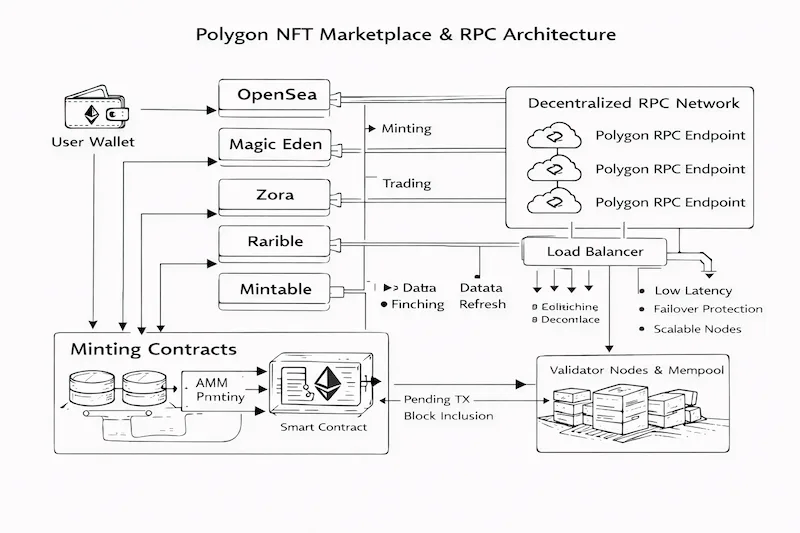
No matter which marketplace you integrate with, RPC performance directly impacts user experience.
dRPC provides decentralized, low-latency Polygon RPC endpoints designed for production NFT workloads.
Benefits for NFT Developers
Faster mint confirmations during drops
Reliable metadata reads for marketplace indexing
Reduced downtime during traffic spikes
No single-provider dependency
For teams operating at scale, RPC reliability becomes as important as smart contract security.
How to Connect Your Polygon NFT Project to RPC
Example using Ethers.js
					import { ethers } from "ethers";

const provider = new ethers.JsonRpcProvider(
  "https://polygon.drpc.org"
);

const blockNumber = await provider.getBlockNumber();
console.log(blockNumber);
Best Practices
Test on Mumbai before mainnet
Use dedicated RPC endpoints for production
Monitor latency and error rates
Avoid shared public endpoints for drops
👉 Connect your Polygon NFT project to dRPC for reliable RPC performance.
FAQs
What is the best Polygon NFT marketplace for developers?
The best Polygon NFT marketplace depends on your needs. Magic Eden and Rarible offer strong developer tooling, while OpenSea provides unmatched distribution.
How do RPC endpoints affect NFT minting?
RPC endpoints handle transaction submission, contract reads, and metadata indexing. Slow or unreliable RPCs directly impact mint speed and marketplace UX.
Which Polygon NFT marketplace supports high-volume projects?
Magic Eden and OpenSea are best suited for high-volume NFT projects due to optimized infrastructure and liquidity depth.
Can one RPC endpoint serve multiple marketplaces?
Yes. A single high-performance RPC endpoint can support multiple NFT marketplace integrations if it is properly load-balanced.
Is dRPC suitable for Polygon NFT development?
Yes. dRPC offers decentralized, low-latency Polygon RPC endpoints optimized for NFT minting, trading, and metadata workloads.
Take-Away
Polygon continues to be one of the best environments for NFT innovation, and selecting the best Polygon NFT marketplace is a critical decision for Web3 developers. Whether you prioritize liquidity, composability, or protocol-level control, the right marketplace combined with reliable RPC infrastructure unlocks scale.
With decentralized, production-ready Polygon RPC endpoints, dRPC ensures your NFT applications stay fast, resilient, and scalable, even during peak demand.