

Overview
This guide explains how developers can connect to BNB Chain rpc, what makes the network attractive to build on, and how to choose the right RPC infrastructure depending on how your application is architected.
It is designed for:
Developers looking for a BNB Chain RPC recommendation
Teams integrating public RPC endpoints or WebSockets
Architects deciding between managed RPC and self hosted RPC
Why Build on BNB Chain
BNB Chain is one of the most widely used EVM compatible networks in production today. It combines:
High transaction throughput
Low and predictable fees
Full EVM compatibility
A mature DeFi and consumer dApp ecosystem
From an infrastructure perspective, BNB Chain is attractive because it supports:
Standard Ethereum JSON RPC methods
WebSocket subscriptions for real time events
Stable block times suitable for trading, gaming, and consumer applications
This makes it straightforward to integrate using existing Ethereum tooling while benefiting from faster execution and lower costs.
What Is a BNB Chain RPC Endpoint
An RPC endpoint is the interface your application uses to communicate with BNB Chain nodes.
RPC endpoints are required to:
Read blockchain state (balances, blocks, logs)
Submit transactions
Interact with smart contracts
Subscribe to real time events via WebSocket
Every wallet, dApp frontend, backend service, indexer, and bot relies on RPC infrastructure.
Public BNB Chain RPC Endpoint
For quick access and lightweight use cases, a public RPC endpoint is available:
Public HTTP RPC endpoint
https://bsc.drpc.org
This endpoint can be used for:
Prototyping
Testing
Read heavy workloads
Simple transaction submission
Public endpoints are shared and rate limited, so they are not recommended for production traffic or latency sensitive applications.
WebSocket RPC Access for BNB Chain
Many applications require real time updates such as:
New blocks
Pending transactions
Contract events
For WebSocket access and production ready configuration, use the BNB Chain RPC page:
https://drpc.org/chainlist/bsc-mainnet-rpc
This page provides:
WebSocket endpoints
Configuration options
Production ready access for BNB Chain
Supported Networks Beyond BNB Chain
BNB Chain is part of a much broader RPC ecosystem.
dRPC provides endpoints for 186 networks, covering:
EVM chains
Layer 2 networks
App specific chains
Emerging ecosystems
You can explore the full list here: https://drpc.org/chainlist
This is especially useful for teams building multi chain applications or planning future expansion.
Choosing the Right RPC Infrastructure Model
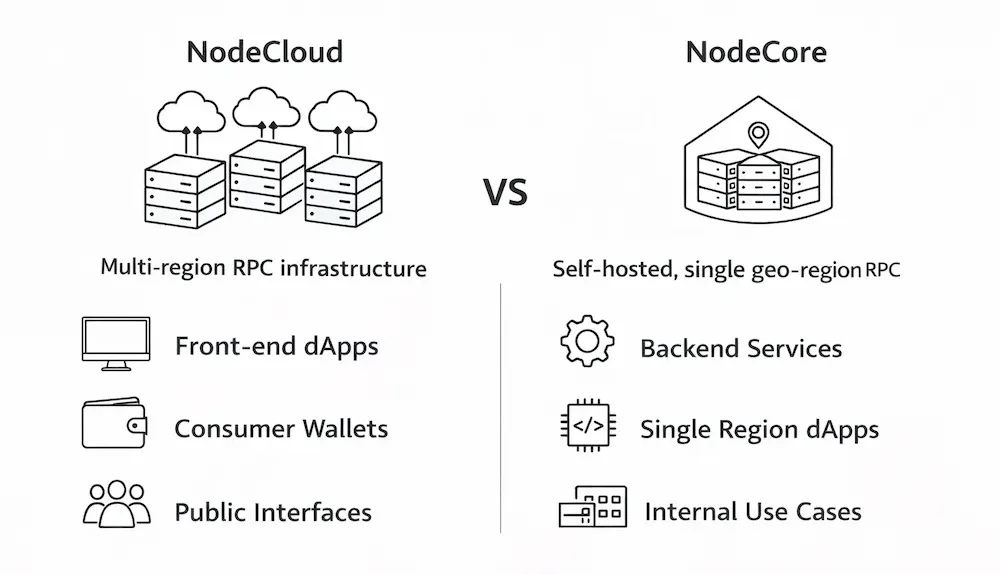
There are two fundamentally different ways to run BNB Chain RPC infrastructure:
Managed cloud RPC
Self hosted RPC inside your own infrastructure
The correct choice does not depend on company size.
It depends on how your application sends traffic.
NodeCloud: Managed Multi Region RPC Infrastructure
NodeCloud is a managed RPC platform designed for applications that serve traffic from many geographic locations.
NodeCloud offers both free and paid RPC access. Free public nodes are available for development and testing, while paid plans unlock unlimited features starting at ten dollars with a pay as you go model.
Pricing is fully predictable, using a flat rate of twenty compute units per RPC method request. This makes NodeCloud well suited for production dApps that need clear cost control while serving global frontend traffic.
NodeCloud page:
https://drpc.org/nodecloud-multichain-rpc-management
When NodeCloud Is the Right Choice
NodeCloud is the correct option if:
A significant portion of your traffic comes from user devices
Requests originate from browsers, wallets, or mobile apps
Your users are globally distributed
You need the closest possible RPC endpoint to the end user
In these scenarios, RPC requests originate from many locations across the world. A single self hosted node or even a small number of regions cannot serve this efficiently.
NodeCloud solves this by:
Routing requests to the closest available region
Providing global load balancing
Handling provider redundancy and failover
Typical NodeCloud Use Cases
Frontend heavy dApps
Consumer wallets
NFT marketplaces
Public trading interfaces
Applications where users interact directly with the chain from their devices
NodeCore: Self Hosted RPC Infrastructure
NodeCore is an open source, on premise RPC stack that runs inside your own infrastructure.
NodeCore page:
https://drpc.org/nodecore-open-source-rpc-infrastructure
When NodeCore Is the Right Choice
NodeCore is the correct option if:
Most or all RPC traffic comes from your backend
Requests originate from one primary region or a small number of regions
You require deep control over infrastructure
You want to minimize third party dependencies
In this model, your backend acts as the single RPC client. Since all requests originate from a known location, latency is predictable and regional distribution is unnecessary.
Typical NodeCore Use Cases
Backend only dApps
Trading engines
Indexers
Internal services
Applications where frontend traffic does not talk directly to RPC endpoints
A Critical Distinction: Frontend Traffic vs Backend Traffic
The most important factor when choosing between NodeCloud and NodeCore is where your RPC requests originate.
Backend Only Traffic
If your architecture sends all RPC requests from:
A backend service
One data center
One primary cloud region
Then NodeCore is often ideal.
User Originated Traffic
If your architecture allows:
Browsers
Mobile apps
Wallet extensions
Client side scripts
to send RPC requests directly, then NodeCore alone is not sufficient.
In these cases:
NodeCloud is required for frontend traffic
NodeCore may still be used for backend traffic
Many production systems use both:
NodeCore for internal services
NodeCloud for public facing traffic
Recommended Architecture Patterns on BNB Chain
Pattern 1: Frontend dApp
NodeCloud for all RPC traffic
Pattern 2: Backend only service
NodeCore for all RPC traffic
Pattern 3: Hybrid architecture
NodeCore for backend services
NodeCloud for frontend and user traffic
Summary: BNB Chain RPC Recommendations
Use https://bsc.drpc.org for public RPC access
Use https://drpc.org/chainlist/bsc-mainnet-rpc for WebSocket and production configuration
Use NodeCloud when traffic comes from users across the globe
Use NodeCore when traffic comes from controlled backend environments
Explore 186 supported networks via https://drpc.org/chainlist
The correct RPC setup is a function of infrastructure design, not company size.