

Introduction
Every blockchain dApp relies on a fundamental layer of infrastructure that sits between the user interface and the underlying network: RPC nodes and RPC endpoints.
They form the transport layer that dApps use to read blockchain state, submit transactions, and interact with smart contracts.
Despite their importance, many developers treat RPC as a “black box” — a simple URL they plug into Web3.js or Ethers.js.
In reality, RPC nodes are highly specialized machines configured to handle large volumes of JSON-RPC requests with predictable throughput, low latency, and high availability.
RPC endpoints act as the publicly exposed access points to these nodes, often behind load balancers, caching layers, georouting systems, or decentralized provider networks.
In this guide, you’ll learn what RPC nodes are, how RPC endpoints work, the difference between the two, and why optimized global endpoints dramatically improve dApp performance.
This is an advanced, production-grade explanation intended for developers, DevOps teams, and CTOs designing scalable blockchain systems.
Understanding RPC Nodes
NODE TYPE
PURPOSE
RUNS CONCENSUS
OPTIMIZED FOR
Validator Node
Produce blocks, validate transactions
Yes
Deterministic uptime and staking security
Full node
Stores and verifies full chain history
No
Data integrity
RPC node
Serves JSON-RPC requests to applications
No
High throughput, low latency
Definition
An RPC node is a blockchain node configured to handle JSON-RPC requests from external applications (dApps, wallets, explorers, backends). Unlike validator nodes, RPC nodes are optimized for data throughput — not consensus.
What RPC Nodes Actually Do
At an engineering level, RPC nodes handle:
State lookups: balances, contract storage, nonce
Execution simulation: eth_call, gas estimation
Historical queries: logs, block data
Transaction broadcast: submitting raw signed transactions
Tracing and debugging: advanced EVM traces (optional)
Filtering: indexed event logs, bloom filters
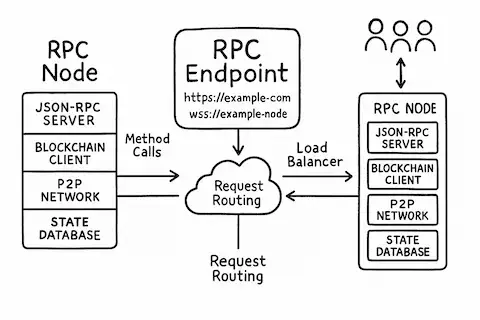
Internally, an RPC node consists of:
Execution layer client (e.g., Geth, Nethermind, Erigon)
Storage layer (state trie, receipts trie, block DB)
Networking layer (P2P gossip, block sync protocols)
RPC service modules (JSON-RPC HTTP, WebSocket, IPC)
RPC nodes often disable:
Consensus duties
Mining / validation responsibilities
Peer-heavy features unnecessary for serving queries
This configuration lets them handle hundreds of thousands of requests per second when scaled horizontally.
For developers who want to review the full JSON-RPC method specification used by most blockchain nodes, see the official Ethereum documentation.
RPC Nodes vs Full Nodes vs Validator Nodes
NODE TYPE
PURPOSE
RUNS CONCENSUS?
OPTIMIZED FOR
Validator Node
Produce blocks, validate transactions
Yes
Deterministic uptime & staking security
Full node
Stores and verifies full chain history
No
Data integrity
RPC Node
Serves JSON-RPC requests to applications
No
High throughput, low latency
RPC nodes are the application-facing layer of Web3 — not the consensus layer.
What are RPC Endpoints?
Definition
An RPC endpoint is a URL or WebSocket address that exposes JSON-RPC functionality from one or more RPC nodes to external applications.
You are not connecting directly to a machine — you are connecting to an access interface.
Examples of RPC Endpoints
https://ethereum.publicnode.com
https://polygon.llamarpc.com
https://bsc-dataseed1.binance.org
https://lb.drpc.live/eth
Endpoints vary in:
latency
throughput
uptime
geographic proximity
provider decentralization
underlying node quality
methods supported (standard vs tracing extensions)
Behind a single RPC endpoint, there may be:
A single RPC node (bad for reliability)
A cluster of nodes behind a load balancer
A decentralized provider network like dRPC
A geo-distributed set of endpoint clusters (US/EU/Asia)
How RPC Endpoints Enable Blockchain Communication
Ethers.js / Web3.js → RPC Endpoint → Load Balancer → Backend RPC Nodes → Blockchain P2P Network.
The RPC endpoint is your entry point. The RPC node is the machine serving the request.
RPC Nodes vs RPC Endpoints: Key Differences
ASPECT
RPC NODE
RPC ENDPOINT
Definition
Machine running node software optimized for RPC
Public access URL to reach RPC nodes
Visibility
Internal infrastructure
Externally exposed interface
Role
Execute JSON-RPC methods
Route requests from clients
Scaling
Vertical + horizontal
Endpoint-level load balancing and georouting
Reliability
Depends on node health
Depends on traffic routing + provider architecture
Examples
Geth node, Erigon node
https://drpc.org/chainlist/eth-mainnet-rpc
The key lesson:
A high-quality RPC endpoint depends entirely on the architecture behind it — not just the URL.
Why High-Quality RPC Endpoints Matter
A poor RPC endpoint slows down your entire application, regardless of how optimized your front-end or backend is.
1. Latency Drives UX
A single RPC request can:
fetch a balance
load a contract state
pull logs for UI rendering
Each request adds latency.
Global, low-latency endpoints reduce time-to-first-render.
2. Endpoints Must Handle Request Spikes
Production apps often generate:
bursts of read calls
parallel contract calls
multi-tenant traffic
Low-quality endpoints rate-limit or timeout.
3. Reliability Impacts Transaction Success
Poor endpoints → stuck transactions → failed swaps → user frustration.
4. Geo Proximity Matters
The closer the endpoint to the user:
fewer network hops
faster HTTPS handshake
lower median latency
This is why global RPC networks outperform regional node providers.
5. Endpoints Impact Multi-Chain Architecture
If your dApp supports multiple networks:
Ethereum
BNB Chain
Polygon
Arbitrum
Base
You need consistent JSON-RPC behavior across them. Bad endpoints break cross-chain abstractions.
For a chain-specific example, the BNB Chain developer documentation provides a detailed overview of its RPC endpoint structure and supported methods.
How RPC Endpoints Work Behind the Scenes
Front-End Routing Layer
This layer terminates:
HTTP requests
TLS handshakes
It may include:
CDN caching layers (for static RPC responses)
HTTP/2 upgrades
Retriable connection pools
Load Balancer
The load balancer selects which RPC node receives the request.
Selection strategies include:
round-robin
least-connections
latency-based routing
regional georouting
provider health scoring
RPC Node Tier
This is the actual machine executing JSON-RPC logic:
execution client (Geth/Nethermind/Erigon)
storage engine
WebSocket server
trie database
Latency here is dictated by:
database access speed
execution client performance
state access patterns
cache hits vs misses
block propagation latency
Provider Network Layer
Traditional RPC providers run:
one central node cluster
few physical locations
Decentralized RPC providers (like dRPC) run:
multiple independent providers
globally distributed clusters
failover routing
latency-aware traffic shifts
This results in:
lower median latency
lower tail latency (p95/p99)
higher resilience
Why Developers Should Care About RPC Architecture
RPC performance creates real-world effects:
Slow RPC → slow dApp
Unreliable RPC → failed transactions
Inconsistent RPC → debugging nightmares
No geo distribution → global users penalized
Provider outages → dApp downtime
The RPC layer is as critical as:
Front-end performance
Backend indexers
DevOps infrastructure
Many devs only realize this when their app scales (and the RPC endpoint can’t keep up).
Global Low-Latency Endpoints with dRPC
dRPC is designed to solve the problems above using:
decentralized provider networks
global endpoint clusters
automatic failover
consistent JSON-RPC support across chains
optimized request routing
multi-chain RPC endpoint exposure
Key Architectural Advantages
Global Geo-Distributed Infrastructure
dRPC routes users to the nearest cluster automatically:
Reduces latency by up to 80%
Lowers p95/p99 variance
Decentralized Providers
Multiple independent node operators:
Reduce risk of provider outages
Improve reliability
Increase redundancy
High-Throughput Design
Optimized for burst loads from:
Wallets
DEXs
Web3 games
Analytics apps
Multi-Chain Support
Everything exposed through a unified interface:
This includes:
Ethereum
BNB Chain
Polygon
Arbitrum
Optimism
Base
Avalanche
Cronos
FAQs
What is an RPC endpoint in blockchain?
An RPC endpoint is a public interface URL that allows dApps to communicate with blockchain nodes via JSON-RPC or WebSocket.
How do RPC endpoints differ from RPC nodes?
RPC nodes are the machines running blockchain clients. RPC endpoints are the access points routing requests to these nodes.
Why are global low-latency RPC endpoints important?
They reduce request time, improve UX, increase transaction success rates, and provide consistent performance worldwide.
Can multiple dApps use the same RPC endpoint?
Yes — production-grade endpoints are shared across applications and load-balanced across multiple nodes.
Does dRPC provide decentralized RPC endpoints?
Yes. dRPC exposes decentralized, high-speed RPC endpoints across 180+ networks.
Take-Away
RPC nodes are the backbone of blockchain data access, responsible for executing JSON-RPC requests at high throughput.
RPC endpoints serve as the entry points that route traffic to these nodes, often across globally distributed clusters.
Understanding the difference between the two and relying on high-quality global endpoints — is essential for building scalable, low-latency, production-grade blockchain dApps.
With decentralized infrastructure and worldwide routing, dRPC offers developers a reliable way to access multi-chain RPC endpoints with speed and consistency.
Start building high-performance dApps using dRPC endpoints today