


Introduction
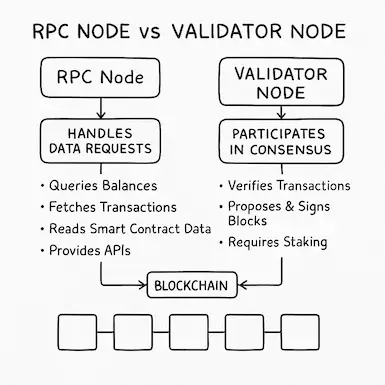
Blockchain networks run on distributed nodes that store data, validate transactions, and serve queries to applications. However, not all nodes perform the same job. dApps often rely on RPC nodes, while blockchain networks depend on validator nodes for consensus and block production.
Confusing these roles leads to poor performance, overloaded infrastructure, and even consensus risks.
This guide breaks down the difference between RPC node vs validator node, clarifies how each fits into the blockchain stack, and explains why separating these responsibilities is essential for scalable and high-performance dApp development.
By the end, you’ll understand why modern infrastructure providers — including decentralized networks like dRPC — run dedicated RPC nodes separate from validators, enabling faster, safer, and more reliable blockchain access.
What Are Blockchain Nodes?
Definition (Developer Box)
A blockchain node is any machine running the network’s client software to store blockchain data, validate transactions, or respond to application requests.
Nodes allow blockchains to function by:
Relaying transactions
Verifying state and signatures
Executing smart contract logic
Serving on-chain data to users and applications
Participating in consensus (validator nodes)
Types of Nodes
Most networks recognize at least three node roles:
Validator nodes — secure the network by validating and proposing blocks
Full nodes — store the blockchain state and verify data without producing blocks
RPC nodes — optimized for responding to application queries via JSON-RPC or WebSocket RPC
Both RPC nodes and validator nodes are commonly mixed in conversation, but they are fundamentally different in purpose.
Learn more from:
Ethereum Nodes and Clients
BNB Chain Official Docs
What is a Validator Node?
Definition
A validator node is a blockchain participant responsible for validating transactions, proposing blocks, and securing the network through consensus.
Validator nodes perform critical network duties, including:
Executing block validation logic
Verifying transaction signatures
Participating in consensus protocols
Attesting to block correctness
Managing staking and slashing conditions
Validator Node Characteristics
ATTRIBUTE
DESCRIPTION
Role
Secure the network, produce blocks
Concensus
Runs consensus logic (e.g., PoS, PoA)
Performance Priority
Stability, uptime, deterministic behaviour
Hardware Needs
High CPU, RAM, reliable SSD, networking
Hardware Needs
Extremely high — downtime risks slashing (PoS networks)
Examples
Ethereum: Requires 32 ETH to run a validator
BNB Chain: Requires delegation + powerful hardware
Polygon PoS: Validators maintain checkpoints and validate blocks
Validator nodes must avoid unnecessary workload. Any excess query traffic or data processing can slow down consensus operations or result in downtime penalties.
Understanding how validator nodes secure the network is essential before comparing rpc node vs validator node responsibilities in real-world blockchain systems.
What is an RPC Node
Definition
An RPC node is a blockchain node optimized for responding to data requests using JSON-RPC or WebSocket RPC. It does not participate in consensus.
RPC nodes support dApps, wallets, explorers, and backend services by answering requests such as:
What is the balance of address X?
What is the latest block number?
What are the logs for this contract?
Simulate a contract call at block N
Broadcast this signed transaction
RPC Node Characteristics
ATTRIBUTE
DESCRIPTION
Role
Serve JSON-RPC / WS RPC requests
Concensus
None, not a block producer
Performance Priority
Query throughput, uptime, low latency
Hardware needs
CPU + I/O optimized for high request volume
Sensitivity
Low — not subject to slashing
RPC nodes are the backbone of:
Wallets (MetaMask, TrustWallet, Coinbase Wallet)
dApps (DeFi, NFT, gaming)
Explorers (block, transaction, logs)
Indexers and analytics engines
Backend services that rely on on-chain data
They are designed for API performance, not validation.
This distinction becomes critical when evaluating rpc node vs validator node roles and deciding how to architect scalable dApp infrastructure.
RPC Node vs Validator Node: Key Differences
Here’s a clear technical comparison to understand the difference between RPC node and validator node:
FEATURE
RPC NODE
VALIDATOR NODE
Primary function
Server data queries
Validate transactions and run consensus
Consensus Participation
❌ No
✅ Yes
Workload type
High-volume API requests
Deterministic block production
Optimized For
Speed, low latency, uptime, scalability
Network security and correctness
Hardware Priority
I/O + Network throughput
CPU + high reliability
Risk overload
Managed with load balancing
Dangerous — impacts consensus
Best Use Case
dApss, wallets, explorers
Securing the blockchain
Why You Should Not Use Validator Nodes for RPC Access
Many early blockchain projects attempted to use validator nodes as “all-purpose nodes,” handling both consensus and high-volume RPC traffic. This is a dangerous and inefficient design for several reasons:
Validator Nodes Cannot Handle Heavy RPC Load
RPC queries (especially logs, traces, block lookups, or large batch calls) consume:
CPU
Disk I/O
Network bandwidth
These compete with consensus duties.
Validator Performance Degrades Under Query Pressure
A validator must keep:
Peer communication stable
Attestations timely
Slot participation consistent
RPC load creates:
Missed attestations
Slow block production
Delayed gossip propagation
This can lead to penalties or slashing on PoS networks.
RPC Queries Can Introduce Latency into Consensus
RPC calls tend to be unpredictable. Blocking RPC threads can:
Interrupt critical consensus rounds
Stall block proposals
Reduce validator reliability
Security Concerns
Validators expose sensitive ports and are not intended to handle public RPC traffic.
Section Take-Away
Never mix roles. A validator node should remain dedicated to securing the chain; RPC nodes should serve queries.
Benefits of Dedicated RPC Nodes
Separating validator and RPC workloads leads to significant performance and reliability improvements.
Faster Query Response Times
RPC nodes are built with:
High-performance hardware (NVMe SSDs, fast CPUs)
Aggressive caching
Optimized database access patterns
This ensures consistent low-latency JSON-RPC responses.
No Risk to Validators
Validator nodes remain stable, ensuring:
High uptime
Consistent block validation
No risk of slashing
Predictable performance
Horizontal Scalability
RPC nodes can be load-balanced to scale with user demand:
Auto-scaling clusters
Decentralized node networks (like dRPC)
Multiple provider redundancy
This design supports millions of queries per second without impacting the network.
Better Developer Experience
Dedicated RPC infrastructure avoids:
Rate limits
Timeouts
Slow queries
Node overload
This makes dApps more stable and reliable in production.
How dRPC Provides Dedicated RPC Nodes for Developers
dRPC is designed specifically to separate validator responsibilities from data responsibility.
dRPC’s Dedicated RPC Infrastructure
dRPC delivers high-performance RPC access using:
Decentralized node providers
No validator overhead
Global load-balanced clusters
Multi-chain support (180+ networks)
Ultra-low latency routing
Failover-ready architecture
This ensures RPC traffic never affects validator operations — and validators never become a bottleneck for dApps.
Developer Benefits
High throughput for RPC queries
Predictable performance
Better security
Greater scalability
Support for both HTTP and WebSocket RPC
You can explore RPC endpoints at:
Explore dRPC’s dedicated RPC node infrastructure
And learn more on the homepage:
dRPC Official Website
FAQs
What is the difference between an RPC node and a validator node?
RPC nodes serve data queries and API calls. Validator nodes participate in consensus and secure the network. Their responsibilities and performance requirements are completely different.
Can a validator node act as an RPC node?
Technically yes, but it is unsafe and inefficient. High RPC load can degrade validator performance and risk slashing or downtime.
Why are RPC nodes important for dApps?
RPC nodes deliver the data dApps need — balances, logs, contract state, transactions — with fast and reliable query performance.
What are the benefits of using dedicated RPC nodes?
They provide low-latency performance, prevent validator overload, and scale horizontally with user demand. These performance advantages highlight why rpc node vs validator node separation is a best practice in modern blockchain infrastructure design.
Does dRPC offer dedicated RPC endpoints?
Yes. dRPC provides dedicated, decentralized RPC nodes across multiple chains with global redundancy.
Take-Away
Understanding rpc node vs validator node is essential for anyone building or operating blockchain applications. Validator nodes secure the network through consensus, while RPC nodes handle high-volume data requests for wallets, dApps, explorers, and backends.
Mixing these roles can lead to performance degradation, validator instability, and user-facing errors. Using dedicated RPC nodes — especially through decentralized networks like dRPC — ensures fast, reliable, and scalable data access without compromising validator performance.
Choose dRPC for high-performance decentralized RPC infrastructure