

Introduction
APIs act as the communication layer between applications and the systems they interact with. In blockchain development, APIs allow dApps, services, scripts, and backend components to communicate with nodes to retrieve state, broadcast transactions, or read contract data.
Two of the most widely used API architectures are REST (Representational State Transfer) and RPC (Remote Procedure Call). Although both serve the purpose of connecting applications to external services, they operate differently — especially in environments where performance, precision, and low-latency data access matter.
In blockchain contexts, the choice between RPC vs REST has significant implications for speed, correctness, and scalability. This guide provides a clear, technical comparison and explains why JSON-RPC is the dominant standard for Ethereum, BNB Chain, Polygon, and other networks — especially when paired with decentralized RPC providers like dRPC. This guide provides a clear developer-focused comparison of RPC vs REST to help you choose the right API model for blockchain workloads.
dRPC provides decentralized RPC endpoints across 180+ networks: https://drpc.org
Understanding APIs in Blockchain Development
APIs allow blockchain applications to communicate directly with network nodes. Every blockchain node exposes an interface through which developers can:
Query account balances
Fetch block data
Broadcast signed transactions
Query contract events
Simulate smart contract calls
While REST and RPC both enable API communication, they differ in structure and performance characteristics.
In blockchain development, speed and precision are critical. A dApp might need to compute on-chain data every block, update UI states rapidly, or retrieve events without delay. This is why the underlying API architecture matters.
What is REST API?
REST is an architectural style built around resources and standard HTTP verbs:
GET /user/123
POST /orders
DELETE /resource/abc
It is stateless, human-readable, and widely used for web applications.
Key Characteristics
Uses HTTP verbs (GET/POST/PUT/DELETE)
Resource-based URL structures
Predictable, simple design
Highly compatible with typical SaaS and backend systems
Advantages
Easy to understand
Widely supported
Strong ecosystem tooling
Good for general web services
Limitations in Blockchain
REST is not optimized for high-frequency or low-latency data retrieval because:
Every query involves multiple layers of interpretation
REST responses are verbose
It works poorly when requests must be repeated every block
Blockchain workloads are inherently method-centric, not resource-centric — making REST a mismatch for typical node operations.
Developer note: A REST API to fetch the current Ethereum block number might require accessing multiple endpoints or composed resources. In contrast, RPC exposes a single method: eth_blockNumber.
Learn more about REST fundamentals from the official Mozilla documentation:
What is RPC (remote procedure call)?
RPC is a communication model where a client directly calls methods/functions on a remote server — similar to calling a local function in code.
Instead of treating data as “resources,” RPC treats node operations as methods:
eth_getBalance
eth_call
eth_blockNumber
eth_sendRawTransaction
In the blockchain world, the most common implementation is JSON-RPC.
JSON-RPC Example
Request:
					{
  "jsonrpc": "2.0",
  "method": "eth_blockNumber",
  "params": [],
  "id": 1
}
Response:
					{
  "jsonrpc": "2.0",
  "id": 1,
  "result": "0x10d4f"
}
For a deeper walkthrough of interacting with contracts using JSON-RPC, see our guide: How to Interact with Web3 Smart Contracts Using Decentralized RPC
https://drpc.org/blog/web3-smart-contract-interaction-decentralized-rpc
Advantages for Blockchain
Lightweight
Direct method invocation
Lower latency than REST
Minimal overhead
Designed for repetitive queries
Enables precise, atomic blockchain interactions
This makes RPC ideal for dApps, explorers, wallets, indexers, and backend processors. When comparing rpc vs rest architectures, RPC aligns more closely with how blockchain nodes operate, because nearly all interactions are method-based rather than resource-based.
In short:
REST is a resource-based API design that uses HTTP verbs to retrieve and manipulate data. Common for traditional web apps but less efficient for blockchain synchronization and state queries.
RPC is a method-based communication protocol enabling direct function calls on a remote server. JSON-RPC is the primary interface for blockchain nodes, optimized for speed and precision.
What is the Difference Between RPC and REST?
Below is a detailed comparison tailored specifically for blockchain workloads.
RPC vs REST Comparison Table
FEATURE
REST
RPC / JSON-RPC
Architecture
Resource-based
Method-based
Usage pattern
GET/POST on URLs
Direct method calls
Typical format
JASON over HTTP
JSON-RPC over HTTP/WebSocket
Overhead
Higher (HTTP stack, routing)
Low (direct method execution)
Latency
Moderate to high
Low
Ideal use case
CRUD apps, microservices
Blockchain node operations
Batch requests
Rare
Native (JSON-RPC batching)
Websocket support
Limited
First-class (subscribe to new blocks/events)
Blockchain compatibility
Poor
Native standard
Performance under load
Degrades faster
Optimized for repetitive calls
Event streaming
Needs custom solutions
Supported via eth_subscribe
Data accuracy
Multi-step queries
Single precise call
Examples
RESTful backend APIs
Ethereum JSON-RPC, BNB RPC, Polygon RPC
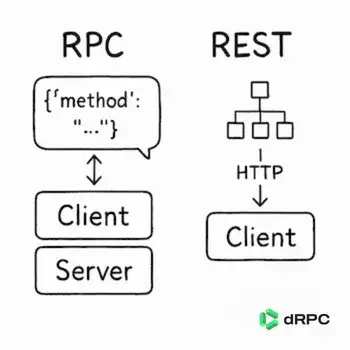
In blockchain workloads, RPC is universally superior due to its direct execution model and lightweight data exchange.
Why RPC Is Better for Blockchain Applications
When comparing rpc vs rest, blockchain workloads favor RPC because most node operations map directly to method calls rather than resource endpoints.
Blockchain nodes continuously process new data every block. A dApp may need to update state rapidly:
Query updated token balances
Fetch new block headers
Simulate contract calls
Poll events
Broadcast transactions
REST introduces overhead and latency that become bottlenecks.
RPC is Method-Centric
Blockchain operations map naturally to methods:
eth_getBalance
eth_estimateGas
eth_getTransactionReceipt
REST forces these into unnatural resource structures.
Lower Latency
RPC eliminates URL routing and resource abstraction, enabling:
Faster response times
Higher request throughput
Better performance during congested network periods
Precise, Atomic Results
RPC returns exactly the requested data (e.g., a block header), not a composed REST resource.
Native Support Across Blockchains
All major chains rely on JSON-RPC:
Ethereum
BNB Chain
Polygon
Avalanche
Base
Arbitrum
Optimism
Multi-Chain Scalability
RPC makes it straightforward for dApps to support multiple chains with consistent method signatures.
Conclusion
For blockchain applications, RPC is not just faster — it’s the architecture the ecosystem is built on.
JSON-RPC: The Core of Blockchain Communication
JSON-RPC is a lightweight, stateless remote procedure call protocol used universally by blockchain nodes. This is one of the key reasons why rpc vs rest decisions in blockchain development almost always favor JSON-RPC over REST-based designs.
Key Characteristics
Minimal JSON payload
Language-agnostic
Transport-agnostic (HTTP or WebSocket)
Batch requests supported
Errors structured cleanly
Example: Fetch Latest Block Number
Request:
					{
 "jsonrpc": "2.0",
 "method": "eth_blockNumber",
 "params": [],
 "id": 1
}
Response
					{
 "jsonrpc": "2.0",
 "id": 1,
 "result": "0x10d4f"
}
Real-World Example: Querying Chain Data via RPC
Why JSON-RPC is Ideal for Blockchain
Extremely fast
Minimal overhead
Works well with continuous polling
Directly aligned with node functionality
See: Ethereum JSON-RPC docs → https://ethereum.org/en/developers/docs/apis/json-rpc/
A simple example using web3.js:
					const Web3 = require("web3");
const web3 = new Web3("https://lb.drpc.live/eth");

async function run() {
  const block = await web3.eth.getBlockNumber();
  console.log("Latest block:", block);
}
run();
The same call via REST (if it existed) would require multiple endpoints, aggregation logic, and conversion steps — much slower and less efficient.
Why Developers Prefer dRPC for JSON-RPC Connections
dRPC provides high-performance, decentralized RPC endpoints for blockchain workloads.
Benefits
Decentralized architecture reduces downtime
Global low-latency routing ensures faster RPC responses
Consistent multi-chain interface
High throughput for repetitive queries
Automatic failover across providers
Developers can interact with dozens of networks using the same base URL.
Try querying blockchain data faster with dRPC’s JSON-RPC endpoints.
FAQs
What is the difference between RPC and REST?
REST is a resource-based API design using HTTP verbs. RPC is a method-based interface where clients call functions directly on a server. Blockchain nodes use RPC for speed and precision.
Why is RPC faster than REST for blockchain APIs?
RPC avoids resource abstraction and reduces data overhead, directly invoking node methods. This leads to lower latency and more efficient queries.
What is JSON-RPC and how does it work?
JSON-RPC is a lightweight protocol for performing remote method calls using JSON. It is the primary interface to blockchain nodes such as Ethereum and BNB Chain.
Can REST be used for blockchain applications?
REST can be used in auxiliary services, but it is not optimal for node communication due to higher overhead and slower data retrieval.
Why is dRPC ideal for JSON-RPC connections?
dRPC offers decentralized node providers, automatic failover, and globally optimized routing — providing faster and more reliable RPC access.
Take-Away
When looking at rpc vs rest, it becomes clear that REST excels in traditional web systems while RPC is built for blockchain performance.
While REST is a great fit for traditional web applications, it is not optimized for high-frequency, low-latency blockchain workloads. Blockchain operations are method-centric and data-intensive, making RPC — specifically JSON-RPC — the best communication model.
RPC enables faster queries, more precise data retrieval, and efficient handling of repetitive node operations. When combined with a decentralized RPC provider like dRPC, developers gain even greater reliability, uptime, and performance across multiple networks.
Connect to decentralized RPC endpoints today at dRPC.