

Introduction
Every blockchain decentralized application (dApp) relies on communication protocols to fetch data and interact with nodes. In Web3, two dominant methods exist: RPC (Remote Procedure Call) and WebSocket connections. These protocols define how your front-end, backend, or indexer retrieves data, listens for updates, and sends transactions.
Choosing between rpc vs websocket is essential for designing efficient, responsive, and scalable dApps. RPC is ideal for one-time state queries, while WebSocket is essential for continuous, real-time data streams. This guide explains both protocols in detail and highlights when to use each — including how decentralized infrastructure like dRPC supports both HTTP RPC and WebSocket RPC endpoints for modern dApps.
What Are Blockchain Communication Protocols?
Blockchain applications need to interact with nodes to:
Fetch account balances
Access contract state
Send signed transactions
Read event logs
Detect new blocks or transactions
These interactions rely on a communication protocol. In Web3, most networks expose data using JSON-RPC, which can be accessed either through:
HTTP RPC requests, or
WebSocket RPC subscriptions
This article covers rpc vs websocket, the strengths of each, and how developers combine them for optimal dApp performance.
What Is RPC (Remote Procedure Call)?
Definition (Developer Box)
RPC is a request-response protocol where a client calls methods on a remote blockchain node, typically using HTTP. The node executes the method and returns the result as a JSON-RPC response.
RPC is the primary method used by Web3 tools and libraries like Web3.js, Ethers.js, Wagmi, Hardhat, and Foundry.
How RPC Works for dApps
A client sends a single HTTP request:
eth_getBalance
eth_getBlockByNumber
eth_call
eth_sendRawTransaction
The node responds with the exact data requested.
Example JSON-RPC request:
					{
  "jsonrpc": "2.0",
  "method": "eth_getBalance",
  "params": ["0x1234...", "latest"],
  "id": 1
}
RPC excels at:
One-off queries
Fetching static or historical data
Sending transactions
Contract state calls
Learn more at:
Ethereum JSON-RPC API Documentation
What Is WebSocket?
Definition (Developer Box)
WebSocket is a real-time, full-duplex communication protocol. Instead of sending individual requests, a persistent connection is established, allowing nodes to push new data instantly to the client.
WebSocket is best for event-driven applications that need:
New block notifications
Live transaction streams
Smart contract event subscriptions
Real-time analytics
WebSocket keeps the connection open, meaning the client receives updates the moment the blockchain changes.
Example WebSocket subscription:
					const ws = new Web3.providers.WebsocketProvider("wss://lb.drpc.live/eth");
web3.setProvider(ws);

web3.eth.subscribe("newBlockHeaders", (err, block) => {
  if (!err) console.log("New block:", block.number);
});
Learn more about WebSocket fundamentals at:
MDN WebSockets API Documentation
RPC vs WebSocket: Key Differences
Below is a comparison table highlighting the main differences between rpc vs websocket for blockchain development:
FEATURE
RPC (HTTP)
WEBSOCKET (WS)
Connection type
Request-response
Persistent real-time connection
Best of
One-time data fetches
Continuous updates
Latency
Slightly higher
Very low
Data flow
Client pulls data
Node pushes updates
Use cases
Balance checks, TX submits
Live events, block streaming
Efficiency
Good for sporadic calls
Excellent for high-frequency data
Bandwith usage
Lower
Higher (persistent)
Supported By
All web3 libraries
Many libraries, fewer frameworks
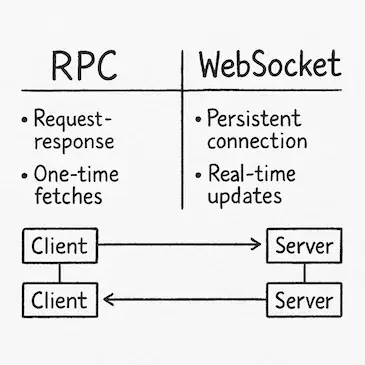
Both protocols are essential — but excel in different scenarios.
When to Use RPC vs When to Use WebSocket
Ideal Use Cases for RPC
RPC is best when your dApp needs discrete data calls:
Fetching a user’s token balance
Getting contract storage values
Simulating contract calls (eth_call)
Submitting broadcasted transactions
Fetching lists of historical blocks or logs
RPC is also the backbone of blockchain queries for:
Wallets
Backends
Frontends
Smart contract testing frameworks
Ideal Use Cases for WebSocket
WebSocket is ideal for real-time features:
Live block updates
Live mempool transaction streams
Automated trading bots
Real-time event dashboards
NFT minting status feeds
dApp notifications (incoming transfers, approvals)
If your app needs instant, streaming updates, WebSocket is the correct choice.
How Modern dApps Combine RPC and WebSocket
Most advanced dApps do not choose between rpc vs websocket.
They use both together:
RPC for:
Reading contract state
Submitting transactions
Fetching large data sets
Checking balances
Running simulations
WebSocket for:
Listening to new blocks
Subscribing to contract events
Building real-time dashboards
Detecting mempool activity
Live transaction confirmations
A trading analytics dApp, for example, may:
Use WebSocket to monitor new trades
Use RPC to fetch token metadata
Use RPC to fetch historical chart data
This hybrid model gives the best performance and the lowest latency.
Support for Both HTTP and WebSocket RPC Endpoints in dRPC
As developers scale their dApps, reliable infrastructure becomes essential. dRPC provides a decentralized RPC network supporting both:
HTTP RPC Endpoints
Used for:
Static queries
Smart contract reads
TX submission
Batch JSON-RPC calls
WebSocket RPC Endpoints
Used for:
Streaming events
Live block headers
Mempool analytics
Event subscriptions
Benefits of dRPC for Both Protocols
Decentralized node provider network
Global geo-distributed clusters
Multi-chain support (180+ networks)
Fast response times and low latency
Automatic failover
Scalable for high-traffic dApps
Developers can start exploring endpoints at:
Real-World Examples of Protocol Usage
Example 1 — Wallet Apps
A Web3 wallet typically uses:
RPC to fetch token balances
WebSocket to detect real-time transfers and block updates
Example 2 — Analytics Dashboards
A blockchain explorer or dashboard uses:
WebSocket to stream blocks
RPC to fetch complete block details
Example 3 — DeFi Platforms
A trading dApp uses:
WebSocket for price triggers
RPC for contract interactions
These real scenarios demonstrate why choosing between rpc vs websocket is not about which is “better,” but which is right for each part of your application.
FAQs
What is the difference between RPC and WebSocket?
RPC is a one-time request–response protocol, while WebSocket maintains a persistent connection for real-time updates.
Is WebSocket faster than RPC?
For streaming data or continuous updates, WebSocket is faster because it avoids repeated HTTP requests.
Can I use both RPC and WebSocket in a dApp?
Yes. Most modern dApps use both: RPC for static queries and WebSocket for live events.
Why do blockchains use JSON-RPC?
JSON-RPC is lightweight, method-based, widely supported, and directly maps to node functionality.
Does dRPC support WebSocket endpoints?
Yes. dRPC supports both HTTP RPC and WebSocket RPC endpoints across multiple chains.
Take-Away
Choosing between rpc vs websocket depends entirely on your dApp’s data access patterns. RPC is ideal for discrete queries such as fetching balances, reading contract state, or sending transactions. WebSocket is the superior choice for live, real-time updates such as new blocks, events, or mempool activity.
In practice, most successful dApps combine both RPC and WebSocket to achieve the best mix of performance, reliability, and responsiveness. With its decentralized global infrastructure and support for both HTTP and WebSocket RPC, dRPC offers the flexibility needed for scalable and high-performance blockchain development.
Build responsive dApps using dRPC’s decentralized RPC infrastructure