

Ethereum decentralized exchanges (DEXs) sit at the core of onchain trading. They power billions in daily volume, enable permissionless access to liquidity, and remove custodial risk from users. But as Ethereum usage scales, security, transaction reliability, and infrastructure quality become just as important as liquidity and UX.
For developers and traders alike, choosing the best Ethereum DEXs for secure trades isn’t just about swap fees or token availability. It’s about smart contract design, audit history, transaction execution guarantees, and the RPC infrastructure that connects wallets, dApps, and trading logic to Ethereum itself.
In this guide, we break down how Ethereum DEXs work, what makes them secure, which platforms lead the market in 2025, and how reliable RPC access — including decentralized RPC infrastructure from dRPC — plays a critical role in secure Ethereum trading. In this guide, we break down what makes the best ethereum dexs suitable for secure, high-volume transactions and long-term DeFi infrastructure.
Understanding Ethereum DEXs
An Ethereum DEX is a decentralized exchange protocol that allows users to trade tokens directly on Ethereum without relying on a centralized intermediary. Trades are executed by smart contracts, and users retain full custody of their assets at all times.
Unlike centralized exchanges, Ethereum DEXs:
Do not hold user funds
Execute trades transparently onchain
Rely on open smart contracts instead of internal order books
Use wallets (MetaMask, WalletConnect, hardware wallets) as the trading interface
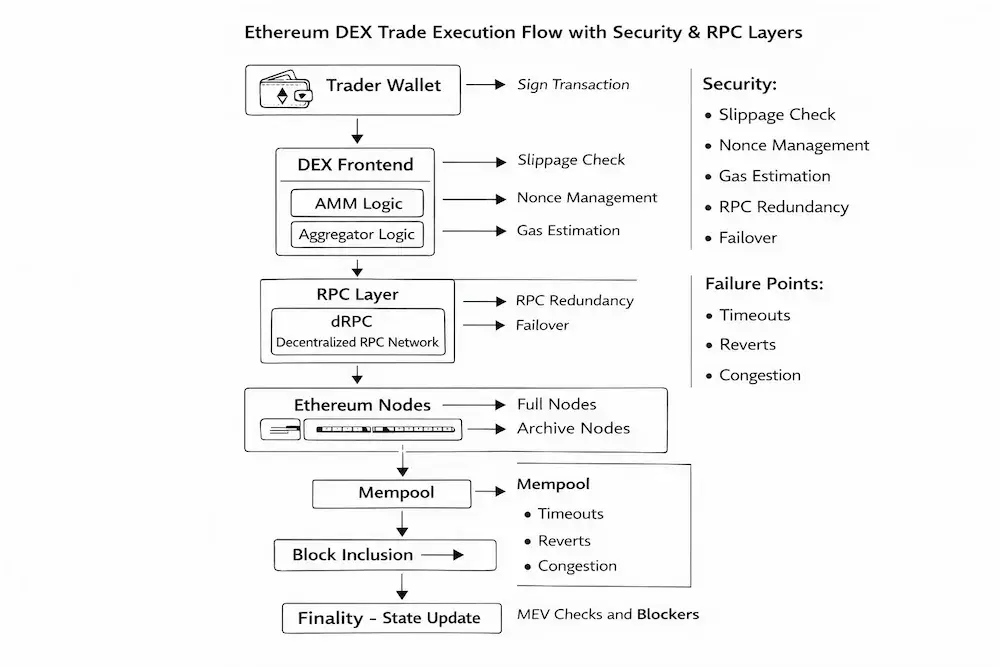
This architecture significantly improves trust minimization. However, it also introduces new dependencies, in particular with RPC endpoints, which act as the bridge between users, applications, and Ethereum nodes.
Every quote, swap, liquidity update, and transaction confirmation flows through RPC infrastructure before reaching the Ethereum network.
What Defines the Best Ethereum DEXs for Secure Trading?
Security on Ethereum DEXs is multi-layered. Smart contracts are critical, but they are not the only component that determines whether trades execute safely and reliably.
Smart Contract Security and Audits
The foundation of any secure Ethereum DEX is well-audited smart contracts. Leading platforms undergo multiple independent audits and maintain bug bounty programs to reduce risk.
Look for:
Reputable audit firms
Transparent audit reports
Long-lived contracts with minimal exploit history
Conservative upgrade mechanisms
Transaction Reliability and Execution Guarantees
Failed transactions cost gas and degrade user trust. Secure DEXs optimize transaction paths, reduce reverts, and handle edge cases like MEV, slippage, and congestion more gracefully.
Liquidity Depth and Market Efficiency
Deep liquidity reduces price impact and protects users from sandwich attacks and extreme slippage. The best Ethereum DEX for secure trades is often the one with the most resilient liquidity during volatility.
Wallet and dApp Integration
DEXs must integrate smoothly with wallets and dApps using standardized Ethereum interfaces. This includes reliable RPC handling for:
Gas estimation
Nonce management
State reads
Transaction broadcasting
Backend Infrastructure and RPC Quality
Even the most secure smart contracts fail users if the underlying infrastructure is unreliable. Poor RPC performance can lead to:
Stale pricing
Missed transactions
Failed confirmations
Inconsistent UI behavior
This is where decentralized, low-latency RPC infrastructure becomes critical.
Top Ethereum DEXs for Secure Trading (2026)
Below is a comparison of leading Ethereum DEXs, evaluated through the lens of security, execution reliability, and infrastructure readiness.
DEX
MODEL
SECURITY TRACK RECORD
LIQUIDITY
GAS EFFICIENCY
DEVELOPER INTEGRATION
AMM
Industry-leading audits
Very high
Optimized (v3+)
Excellent
AMM
Mature, multi-chain
High
Moderate
Strong
Aggregator
Audited routing engine
Aggregated
Optimized
Excellent
Weighted AMM
Highly audited
High
Variable
Advanced
Liquidity hub
Strong audit history
Moderate-high
Optimized
Flexible
While metrics like liquidity and gas efficiency vary, the best ethereum dexs consistently combine audited smart contracts, deep liquidity, and reliable RPC access to ensure trades execute securely under load.
Uniswap
Uniswap remains the benchmark Ethereum DEX for secure trading. Its v3 architecture introduced concentrated liquidity, reducing slippage and improving capital efficiency. Extensive audits and battle-tested contracts make it a default choice for secure Ethereum swaps.
SushiSwap
Originally a Uniswap fork, SushiSwap has evolved into a broader DeFi platform. While more experimental at times, it maintains strong security practices and diversified liquidity across Ethereum and L2s.
1inch
1inch is not a DEX itself but an aggregator that routes trades across multiple Ethereum DEXs. Its security advantage lies in optimal routing, reduced slippage, and protection mechanisms that improve execution quality for large trades.
Balancer
Balancer enables customizable liquidity pools with multiple assets and dynamic weights. This flexibility makes it powerful for advanced strategies but also increases complexity. Its strong audit posture keeps risk manageable.
Kyber Network
Kyber focuses on liquidity aggregation and onchain market making. Its infrastructure-oriented design makes it attractive for dApps that need reliable, composable liquidity.
How dRPC Supports Secure and Fast Ethereum DEX Trading
Security does not stop at smart contracts. RPC infrastructure is a critical but often overlooked attack surface in Ethereum trading. For developers building on the best ethereum dexs, decentralized RPC infrastructure is essential to avoid failed transactions, stale state reads, and execution delays during peak activity.
dRPC provides decentralized Ethereum RPC endpoints designed to support high-throughput, low-latency, and fault-tolerant access to Ethereum Mainnet and testnets.
Why RPC Infrastructure Matters for Ethereum DEXs
Every Ethereum DEX interaction relies on RPC for:
Reading pool state
Estimating gas
Broadcasting transactions
Confirming execution
Centralized RPC providers introduce single points of failure, rate limits, and regional bottlenecks — all of which degrade trading reliability.
Benefits of dRPC for Ethereum DEXs
Decentralized provider network reduces outage risk
Low-latency routing improves trade execution timing
Reliable uptime during peak market volatility
Consistent state reads for accurate pricing and slippage control
For developers building or integrating Ethereum DEXs, dRPC offers infrastructure that aligns with DeFi’s decentralization and security principles.
👉 Connect your Ethereum DEX to dRPC for fast and secure transactions.
How to Connect Your DEX or Wallet to Ethereum RPC
Integrating reliable Ethereum RPC endpoints is straightforward, but critical.
Example using Ethers.js
					import { ethers } from "ethers";

const provider = new ethers.JsonRpcProvider(
  "https://ethereum.rpc.drpc.org"
);

const blockNumber = await provider.getBlockNumber();
console.log(blockNumber);
This endpoint can be used across:
Trading bots
DEX frontends
Wallet integrations
Backend indexers
Testnet First, Mainnet Later
Always validate integrations on Sepolia or Goerli before deploying to Mainnet. Reliable RPC behavior in testing environments helps avoid costly failures in production.
👉 Explore reliable Ethereum RPC endpoints for DEX integration.
FAQs
What is the best Ethereum DEX for secure trades?
Uniswap is widely considered the best Ethereum DEX for secure trades due to its audit history, liquidity depth, and battle-tested contracts. Aggregators like 1inch further improve execution security.
How does RPC infrastructure affect Ethereum DEX performance?
RPC infrastructure determines how reliably transactions are submitted, confirmed, and displayed. Poor RPC performance can cause failed trades, stale pricing, and lost opportunities.
Which Ethereum DEX has the highest liquidity?
Uniswap consistently leads Ethereum DEX liquidity, followed by aggregators like 1inch that route across multiple pools.
Can I use the same RPC endpoint for multiple DEX integrations?
Yes. A high-quality Ethereum RPC endpoint can support multiple DEXs, wallets, and applications simultaneously, provided it scales reliably.
Is dRPC suitable for high-volume Ethereum trading?
Yes. dRPC’s decentralized architecture and low-latency routing are designed to support high-throughput Ethereum trading and DeFi workloads.
Take-Away
Ethereum DEXs are foundational to decentralized finance, but secure trading requires more than smart contracts alone. Choosing among the best ethereum dexs requires evaluating not just protocol design, but also the reliability of the RPC infrastructure that powers every transaction.
Liquidity depth, execution reliability, and infrastructure quality all determine whether trades succeed safely and consistently.
Choosing the best Ethereum DEX for secure trades means evaluating both protocol design and the RPC infrastructure beneath it. Decentralized, low-latency RPC access is essential for protecting users, maintaining uptime, and ensuring accurate transaction execution.
With decentralized Ethereum RPC endpoints built for performance and resilience, dRPC enables developers and traders to interact with Ethereum DEXs securely, reliably, and at scale.
👉 Explore dRPC’s Ethereum RPC endpoints and build secure DeFi infrastructure today.