Polygon has become one of the most widely adopted Layer 2 ecosystems for DeFi, thanks to its low transaction fees, fast confirmations, and seamless compatibility with Ethereum tooling. As DeFi activity grows on Polygon, decentralized exchanges play a critical role in enabling safe, non-custodial token swaps and liquidity provisioning at scale.
For developers and traders alike, choosing the best Polygon DEX is not just about fees or UI — it’s about transaction safety, liquidity depth, smart contract reliability, and the infrastructure that powers every trade. In this guide, we break down the 5 best Polygon DEXs for safe transactions, while also explaining how reliable RPC infrastructure underpins secure and high-performance DeFi applications.
What is a Polygon DEX?
A Polygon DEX is a decentralized exchange deployed on the Polygon network that allows users to swap tokens directly from their wallets without relying on centralized intermediaries. These exchanges use smart contracts to execute trades, manage liquidity pools, and enforce pricing logic.
Because Polygon offers faster block times and significantly lower gas fees than Ethereum mainnet, DEXs on Polygon can deliver near-instant swaps with minimal transaction costs. This makes Polygon especially attractive for high-frequency traders, DeFi protocols, and consumer-facing applications.
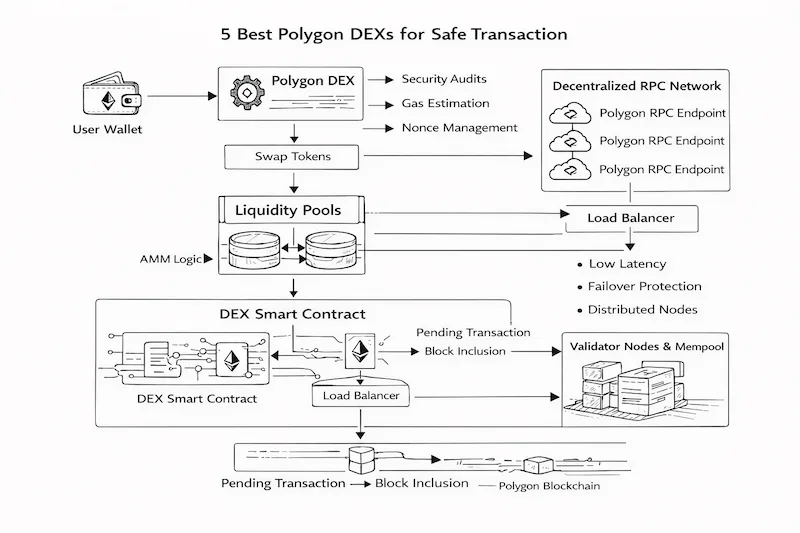
Behind every Polygon DEX is a network of RPC endpoints that wallets and dApps use to read blockchain state, submit transactions, and monitor confirmations. Safe transactions depend not only on smart contracts, but also on reliable RPC access that prevents dropped transactions, stale state reads, or network bottlenecks.
Key Criteria for Choosing the Best Polygon DEX
Before diving into specific platforms, it’s important to understand what makes a Polygon DEX suitable for safe transactions.
Security and audits
DEX smart contracts should be audited by reputable firms and battle-tested under real-world conditions. Transparent upgrade mechanisms and clear governance processes reduce systemic risk.
Transaction speed and finality
Fast execution matters, especially during volatile market conditions. Polygon’s low latency is an advantage, but DEX design and infrastructure choices still impact real-world performance.
Liquidity depth
High liquidity minimizes slippage and protects users from price manipulation. A DEX with shallow pools may expose traders to unsafe execution during large swaps.
Wallet and dApp integration
DEXs should integrate cleanly with major wallets and developer frameworks, enabling safe interaction without custom workarounds.
Infrastructure reliability
RPC availability directly affects transaction safety. Rate-limited or centralized RPCs can lead to failed swaps, delayed confirmations, or degraded UX, especially during high-volume periods.
Top 5 Polygon DEXs for Safe Transactions (2026)
Below are the five Polygon DEXs that consistently stand out for security, liquidity, and developer reliability.
QuickSwap
QuickSwap is the most widely used and liquid decentralized exchange on Polygon. Built as a fork of Uniswap, it uses a familiar AMM model optimized for Polygon’s low-cost environment.
QuickSwap’s strength lies in its deep liquidity pools, broad token support, and strong ecosystem integrations. Many Polygon-native projects list their tokens on QuickSwap first, making it a default choice for safe swaps.
Security audits, mature contracts, and high daily volume make QuickSwap one of the safest options for both users and developers building on Polygon.
SushiSwap (Polygon)
SushiSwap’s Polygon deployment brings the full Sushi ecosystem — including AMMs, yield strategies, and governance — to a faster and cheaper execution layer.
On Polygon, SushiSwap benefits from reduced gas costs while retaining strong liquidity incentives and well-audited contracts. Its multi-chain experience and active development community make it a solid option for teams seeking reliability across environments.
SushiSwap is especially attractive for projects that already operate on Ethereum but want safer, cheaper transaction execution on Polygon.
Dfyn
Dfyn is a Polygon-native DEX designed specifically for fast, low-cost swaps and cross-chain liquidity access. It focuses on minimizing friction for everyday traders while offering predictable execution behavior.
Dfyn’s emphasis on Polygon-first deployment reduces complexity and dependency on Ethereum mainnet congestion. For developers targeting Polygon users exclusively, this specialization can translate into safer and more consistent transaction flows.
ComethSwap
ComethSwap is a community-driven Polygon DEX with a strong focus on usability, composability, and ecosystem incentives. It integrates closely with Polygon tooling and supports a range of DeFi primitives.
While smaller in volume than QuickSwap or SushiSwap, ComethSwap offers transparent governance and well-maintained contracts, making it suitable for projects prioritizing ecosystem alignment and user trust.
Polycat Finance
Polycat Finance extends beyond simple swaps into yield optimization and DeFi tooling built natively on Polygon. Its DEX component focuses on efficiency and capital optimization rather than raw trading volume.
For users seeking integrated DeFi strategies with controlled risk exposure, Polycat offers a different model that still benefits from Polygon’s fast and low-cost execution.
Polygon DEX Comparison Table
DEX
MODEL
LIQUIDITY
SPEED
RPC INTEGRATION
FEES