
Solana has become one of the most important ecosystems for NFT builders. High-throughput execution, low fees, and fast finality have made it the default choice for large-scale NFT minting platforms, marketplaces, and gaming-driven NFT applications
But as Solana NFT projects scale, infrastructure becomes the real differentiator. During high-demand mint events, even small RPC bottlenecks can cause failed transactions, broken user experiences, and reputational damage. That’s why choosing the best Solana RPC for NFT projects is no longer a secondary decision — it’s a core architectural choice.
Solana-native providers like Helius have raised the bar for RPC performance and developer tooling. At the same time, teams building globally distributed NFT platforms are increasingly evaluating decentralized RPC infrastructure to improve resilience, geographic performance, and censorship resistance. This guide explains how Solana RPC works, why RPC speed matters for NFTs, how to evaluate providers, and where dRPC fits into a modern Solana NFT stack. Choosing the best Solana RPC for NFT projects is critical for teams that want reliable minting, fast confirmations, and a smooth user experience during peak demand.
Understanding Solana RPC and Its Role in NFT Development
What Is Solana RPC?
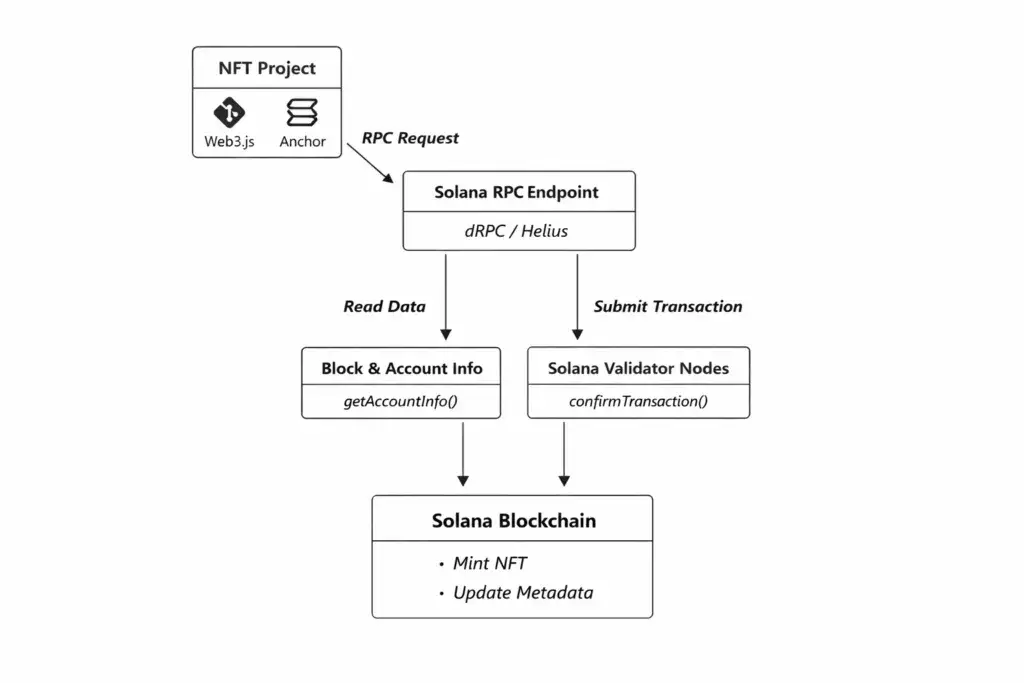
RPC (Remote Procedure Call) endpoints are the primary interface between applications and the Solana blockchain. NFT applications do not communicate directly with validator nodes. Instead, every action flows through an RPC endpoint.
For Solana NFT projects, RPC endpoints power:
Mint transactions and signature submission
Metadata reads and account lookups
Transaction confirmation polling
Marketplace order books and updates
Wallet connectivity and UX
Each NFT interaction typically triggers multiple RPC calls, especially during mint events where thousands of users interact simultaneously.
Why Solana RPC Is Especially Critical for NFTs
Solana’s parallel execution model enables extremely high throughput, but it also places heavy demands on RPC infrastructure. NFT minting programs, such as Candy Machine or custom mint logic, generate bursts of traffic that can overwhelm under-provisioned RPC setups.
Reliable Solana RPC access ensures:
Faster metadata propagation after mint
Consistent confirmation tracking
Reduced transaction retries
Stable marketplace indexing
Without high-quality RPC infrastructure, even well-written NFT smart contracts struggle in production.
Why RPC Speed Matters for Solana NFT Projects
Latency Directly Affects Mint Success
In Solana NFT drops, milliseconds can decide outcomes. Slow RPC responses cause:
Missed whitelist mints
Wallet timeouts
Transaction collisions
UI desynchronization during mint
For competitive launches, RPC latency becomes just as important as on-chain logic. This is why identifying the best Solana RPC for NFT projects often determines whether a launch succeeds or fails under real-world load.
Public RPCs vs Dedicated RPC Endpoints
Public Solana RPC endpoints are suitable for development and testing, but they are rarely sufficient for production NFT launches. Common limitations include:
Strict rate limits
Shared traffic across unrelated apps
No performance guarantees
Inconsistent confirmation speed
Dedicated and professional RPC providers isolate capacity, optimize routing, and reduce contention during peak usage.
Congestion and Confirmation Reliability
During large NFT launches, Solana experiences localized congestion. RPC endpoints must:
Rapidly broadcast signed transactions
Track finalized slots accurately
Retry failed requests intelligently
The best Solana RPC for NFT projects minimizes confirmation delays even when the network is under pressure.
Key Factors When Choosing the Best Solana RPC Provider
Selecting a Solana RPC provider for NFT development requires evaluating several technical dimensions.
Uptime and Reliability
NFT launches are unforgiving. Even short outages can permanently damage a project’s reputation.
Low-Latency Performance
Global NFT communities demand fast responses across regions. Sub-150ms latency is typically considered ideal.
Decentralization and Resilience
Centralized RPC setups create single points of failure. Decentralized routing improves fault tolerance and reduces dependency on any single operator.
Scalability Under Load
NFT mints generate sudden traffic spikes. RPC infrastructure must scale instantly without throttling or degradation.
Developer Tooling and Monitoring
Advanced NFT teams benefit from analytics, monitoring, indexing, and event subscriptions.
Top Solana RPC Providers (Comparison 2026)
When evaluating the best Solana RPC for NFT projects, developers should compare not only raw latency, but also decentralization, scalability, and how each provider behaves during high-volume NFT events. Below is a high-level comparison of leading Solana RPC providers used by NFT developers today.
PROVIDER
LATENCY
UPTIME
DECENTRALIZED
PRICING
NFT STRENGTHS
Very low
Very high
Centralized
Premium
Solana-native APIs, NFT indexing, webhooks
Low
High
Decentralized
Flexible
Global routing, resilient mint infrastructure
Low
High
Centralized
Tiered
Enterprise tooling, analytics
Low
High
Centralized
Premium
Dedicated nodes, monitoring
Medium
Medium
Semi-centralized
Premium
Broad chain coverage
Why Helius Leads Solana RPC Today
Helius is widely recognized as the leading Solana RPC provider. Built specifically for Solana, it offers:
Ultra-low latency endpoints
Native NFT indexing
Real-time webhooks
Enhanced Solana APIs
Many large NFT marketplaces and tooling providers rely on Helius because of its deep Solana-specific optimizations and developer experience.
Official site: https://www.helius.dev/
Helius vs dRPC: Architectural Differences
Helius and dRPC solve different but complementary problems.
Helius
Optimized for Solana-native indexing and events
Centralized architecture with powerful tooling
Excellent for marketplaces, analytics, and webhooks
Ideal when Solana-specific features are the priority
dRPC NodeCloud
Focused on decentralized RPC access
Routes requests across independent providers
Improves resilience, geographic distribution, and neutrality
Ideal for NFT platforms prioritizing uptime, censorship resistance, and global performance
In practice, many advanced teams use Helius for indexing and events, while relying on dRPC for decentralized transaction submission and read access.
Why dRPC Is the Best Decentralized Solana RPC for NFT Projects
Decentralized Solana RPC Infrastructure
dRPC operates a distributed RPC network rather than a single centralized cluster. Requests are routed across independent node providers, reducing the risk of outages during high-traffic NFT launches.
Optimized for Minting and Reads
NFT minting involves heavy write operations, while marketplaces rely on fast reads. dRPC balances both through intelligent routing and node health monitoring.
Global Performance
NFT projects attract users worldwide. dRPC’s global routing minimizes regional latency disparities, making launches fairer and more consistent.
Cost-Efficient Scaling
NFT traffic is spiky. dRPC’s flexible pricing and scalable architecture are well-suited for launch-driven usage patterns.
Explore dRPC’s Solana RPC endpoints for NFT applications:
How to Connect Your NFT Project to Solana RPC
Using Solana Web3.js
					import { Connection } from "@solana/web3.js";

const connection = new Connection(
  "https://solana.rpc.drpc.org",
  "confirmed"
);

const blockHeight = await connection.getBlockHeight();
console.log(blockHeight);
This setup supports:
Mint transactions
Token account reads
Confirmation tracking
Anchor Framework
Anchor users can swap the RPC URL in their provider configuration to point to dRPC without modifying program logic.
Testing on Devnet
Before mainnet launches, test NFT logic on Solana Devnet to validate throughput and error handling.
FAQs
What is the best Solana RPC for NFT projects?
Helius is the leading Solana-native RPC provider, while dRPC is the best decentralized Solana RPC option for NFT projects requiring resilience and global distribution.
Why is RPC speed important for NFT minting?
RPC speed determines how quickly transactions are submitted and confirmed, directly affecting mint success rates and user experience.
Can I use public Solana RPCs for NFT launches?
Public RPCs are not recommended for production NFT drops due to rate limits and instability.
How do I connect to Solana RPC with Web3.js?
Use the Connection class from @solana/web3.js with a reliable RPC endpoint.
Is dRPC suitable for Solana NFT platforms?
Yes. dRPC’s decentralized architecture makes it suitable for NFT platforms prioritizing uptime, fairness, and resilience.
Take-Away
Solana NFT projects demand infrastructure that can handle extreme throughput, unpredictable spikes, and global user bases. While Solana-native providers like Helius lead in indexing and developer tooling, decentralized RPC infrastructure plays a critical role in ensuring resilience and neutrality.
Choosing the best Solana RPC for NFT projects often means combining strengths: Solana-optimized tooling where needed, and decentralized RPC access where reliability and distribution matter most.
For NFT teams building at scale, dRPC offers a powerful, decentralized foundation for Solana connectivity — especially during the moments that matter most.
Ultimately, the best Solana RPC for NFT projects is the one that balances speed, reliability, and architectural resilience. While Solana-native providers like Helius excel at indexing and tooling, decentralized RPC infrastructure such as dRPC plays a critical role in ensuring fairness, uptime, and global performance during NFT launches.