

The rise of EVM chains has fundamentally changed how Web3 applications are built and deployed. Instead of committing to a single network, developers can now ship the same smart contracts and backend logic across multiple blockchains with minimal changes. This shift has unlocked new levels of scalability, user reach, and resilience, but it has also introduced new infrastructure challenges.
At the center of this transition sits RPC infrastructure. Reliable RPC endpoints are what make multi-chain dApp development possible in practice, not just in theory. In this guide, we’ll break down how EVM chains work, why teams deploy across multiple networks, and how decentralized RPC infrastructure enables seamless cross-chain connectivity for production-grade dApps.
What Are EVM Chains?
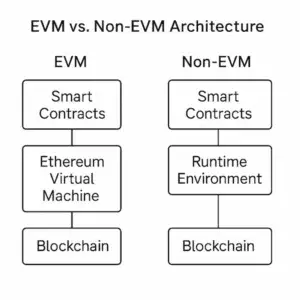
EVM chains are blockchains that implement the Ethereum Virtual Machine (EVM) — the execution environment originally designed for Ethereum smart contracts. The EVM defines how smart contracts are compiled, executed, and how state transitions occur across the network.
Because EVM-compatible chains share the same runtime model, developers can write contracts once and deploy them across multiple networks without rewriting business logic. This shared execution layer is the reason EVM chains have become the foundation of modern Web3 development.
Common examples of EVM-compatible chains include:
Each of these networks supports Solidity-based smart contracts and exposes standard JSON-RPC interfaces for interaction. According to the Ethereum Foundation’s documentation, the EVM acts as a distributed state machine, ensuring consistent execution across nodes and clients .
For developers, this consistency means tooling, libraries, and deployment pipelines remain largely identical across chains — a critical enabler for multi-chain architectures
Why Developers Build on Multiple EVM Chains
The move toward multiple EVM chains is driven by practical production needs rather than ideology alone. Teams that deploy across more than one network gain tangible advantages that single-chain deployments struggle to offer.
Broader user access and liquidity
Different EVM chains attract different user bases. By deploying on multiple networks, dApps can reach users where they already operate, rather than forcing migrations.
Scalability and cost optimization
High gas fees and congestion on one chain can be mitigated by routing users to alternative EVM-compatible chains with lower transaction costs.
Network redundancy
Relying on a single chain introduces a single point of failure. Multi-chain deployments improve uptime and resilience during network congestion or partial outages.
Faster iteration and experimentation
Developers can test features, incentives, and scaling strategies on smaller EVM chains before rolling changes out across the entire ecosystem.
These advantages explain why building dApps on EVM chains has evolved from an advanced strategy into a baseline expectation for many Web3 teams.
Role of RPC Infrastructure in Multi-Chain Development
RPC (Remote Procedure Call) infrastructure is the connective tissue between dApps and blockchain networks. Every read operation, transaction submission, and contract interaction flows through an RPC endpoint.
When working with multiple EVM chains, RPC infrastructure becomes even more critical. Developers must manage:
Different RPC URLs per network
Consistent performance across regions
Failover and load balancing
Rate limits and request throughput
Without a unified approach, RPC management quickly becomes operationally complex.
A decentralized RPC provider abstracts this complexity by offering standardized access to EVM RPC endpoints across networks. Instead of maintaining separate infrastructure for each chain, developers can rely on a single integration layer that routes requests efficiently.
Setting Up Multi-Chain RPC Connections
At a technical level, multi-chain development begins with configuring RPC URLs for each supported network. For example:
					Ethereum Mainnet → https://ethereum.rpc.drpc.org
BNB Chain        → https://bsc.rpc.drpc.org
Polygon          → https://polygon.rpc.drpc.org
Challenges of Multi-Chain dApp Deployment
These endpoints expose identical JSON-RPC interfaces, making them interchangeable from an application logic perspective.
Dynamic chain handling in application code
Most production dApps avoid hard-coding RPC endpoints. Instead, they dynamically select RPC URLs based on:
User-selected network
Wallet configuration
Backend routing logic
Using libraries like ethers.js or web3.js, developers can switch providers at runtime without modifying contract logic. The Web3.js documentation provides detailed examples of provider configuration and network switching patterns .
This flexibility is one of the reasons multi-chain dApp development has scaled so quickly across EVM-compatible ecosystems.
While EVM chains simplify contract portability, deploying across multiple networks introduces new operational challenges.
Endpoint management
Each chain requires reliable RPC endpoints with consistent performance. Poor endpoint quality directly impacts user experience.
Network congestion and rate limits
Traffic spikes on one chain can overload RPC providers, leading to timeouts or failed requests if infrastructure is not properly distributed.
State synchronization
Ensuring a consistent UX across chains requires careful handling of balances, transactions, and indexing layers.
Latency and geography
Users expect fast responses regardless of location. Centralized RPC setups often struggle to deliver low latency globally.
These challenges highlight why RPC infrastructure must scale alongside the application — not as an afterthought.
How dRPC Enables Scalable Multi-Chain dApp Development
dRPC is designed specifically to support building dApps on EVM chains at scale. Rather than operating as a single centralized endpoint, dRPC routes requests through a decentralized network of infrastructure providers.
Key benefits include:
Unified global RPC infrastructure
Developers access multiple EVM chains through a single integration layer, reducing operational complexity.
Low-latency performance
Requests are routed to the closest healthy nodes, minimizing response times across regions.
Decentralized reliability
By distributing traffic across independent providers, dRPC avoids single points of failure and improves censorship resistance.
Easy multi-chain integration
Adding support for new EVM-compatible chains does not require re-architecting the application.
If you want to see supported networks and endpoints, you can access multi-chain EVM RPC endpoints on dRPC via the chainlist: https://drpc.org/chainlist.
Build cross-chain dApps using dRPC’s multi-chain RPC endpoints.
FAQs
What are EVM chains in blockchain?
EVM chains are blockchains that implement the Ethereum Virtual Machine, allowing them to execute Solidity smart contracts and expose standardized JSON-RPC interfaces.
Can I deploy one dApp across multiple EVM chains?
Yes. Because EVM chains share the same execution environment, smart contracts can be deployed across multiple networks with minimal changes.
How do RPC endpoints work with EVM chains?
RPC endpoints act as gateways between applications and blockchain nodes, enabling reads, writes, and smart contract interactions.
What makes dRPC ideal for multi-chain dApps?
dRPC offers decentralized, low-latency RPC infrastructure with unified access across multiple EVM-compatible chains.
Is multi-chain deployment secure and reliable?
When paired with decentralized RPC infrastructure and proper monitoring, multi-chain deployment improves resilience and reduces dependency on single networks.
Take-Away
The expansion of EVM chains has reshaped how decentralized applications are built, scaled, and maintained. Multi-chain deployment is no longer a niche strategy — it’s a core requirement for reaching users, managing costs, and maintaining uptime.
RPC infrastructure is what makes this model viable. Without reliable, decentralized RPC access, multi-chain architectures quickly become fragile and complex. By standardizing access to EVM RPC endpoints and distributing traffic globally, decentralized RPC providers remove many of the operational barriers developers face.
If your goal is to deploy faster, scale reliably, and support multiple EVM chains without sacrificing performance, investing in robust RPC infrastructure is essential.